
For Giselle Castillejos teaching begins before you even enter the classroom. “Learning doesn’t start with the curriculum,” she says. “It starts with connection.”
A fifth-year Concurrent Education (ConEd) student, Giselle recently completed her first full seven-week practicum at Regiopolis-Notre Dame Catholic High School in the Algonquin & Lakeshore Catholic District School Board, teaching Grades 10 and 12 English. It was her first time leading her own English classes, planning lessons, assessing student work, and stepping into the role of teacher.
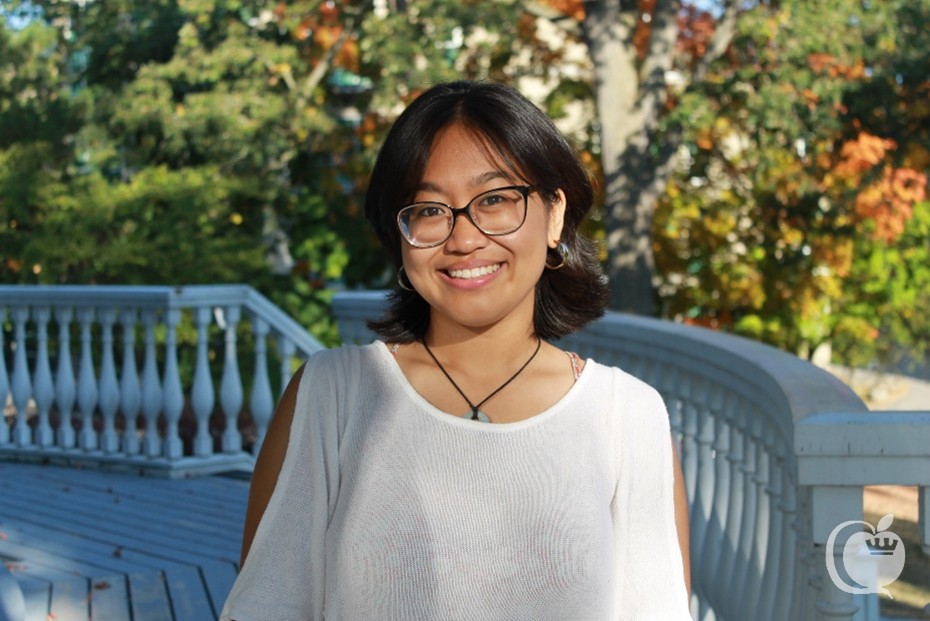 What emerged from her practicum experience was a confirmation that teaching was where she belonged. “I didn’t leave thinking, ‘Oh, teaching is something completely different than I imagined,’” she reflects. “I left thinking, ‘This is exactly why I’m here.’”
Giselle’s path to teaching has been rooted in the arts. A graduate of Queen’s Dan School of Drama and Music, with teaching subjects in Drama and English, Giselle is in the Artist in Community Education (ACE) stream and has spent the past year immersed in conversations about play, imagination, and the role of the arts in shaping meaningful learning experiences for her future students.
“For me, ACE classes have reaffirmed the importance of arts education and providing a positive, encouraging space for students to express themselves and find a sense of belonging,” she says.
That expansive view of education began long before university. Growing up in Guelph, Ontario, Giselle was heavily involved in student leadership and arts programming throughout high school. During the COVID-19 pandemic, she served as arts council president, helping to reimagine how creativity could survive, and even thrive, in isolation. Her team launched online showcases of student artwork, hosted virtual coffee houses, and created spaces where peers could share music, writing, and visual art from home.
“It was a time when people really needed community,” she says. “The arts gave us a way to stay connected.”
An even earlier influence came in elementary school, when Mr. O, Giselle's fourth-grade teacher, handed her a passage to read aloud at a school mass and told her he believed she could do it. Standing in front of her school community, heart racing as she read the passage, sparked a confidence in sharing her voice.
“Mr. O has always shown me what it means to teach through kindness, gratitude, and trust,” Giselle says. “These are values I try to carry with me every day.”
Those values shaped her approach at Regiopolis, where she worked closely with associate teacher Alanna Larsen, Head of the English Department. Giselle describes the first days of her practicum as a mix of excitement and nerves as she learned her way around the building, the routines, and the names. But she quickly felt grounded by the school’s welcoming and vibrant culture.
“From the students to the staff, there was this sense of, ‘You belong here,’” she says. “That makes such a difference when you’re learning how to teach.”
In the classroom, Giselle brought her drama background into her English lessons, designing activities that encouraged movement, collaboration, and curiosity. In one lesson focused on a famous scene from Macbeth, she asked students to cover white t-shirts in marker, then attempt to wash the stains away. The exercise, inspired by close friend and ACE colleague Yashia Allen, became a tangible metaphor for guilt and consequence about how some actions, once taken, cannot be erased.
“They didn’t just understand the theme,” she says. “They felt it.”
Other lessons focused on building confidence, particularly for students who are unaccustomed to acting in front of their peers. When introducing monologues to her Grade 12 IB class, Giselle acknowledged students’ hesitation and reframed the task as an opportunity to grow rather than perform perfectly.
“I always explain the ‘why’ behind an assignment,” she says. “I want students to know I’m challenging them because I believe in them.”
Throughout the practicum, Giselle leaned heavily on strategies emphasized in her coursework at Queen’s including inquiry-based learning, differentiated instruction, and creating classroom norms that prioritize respect. One framework she implemented consistently was the “one voice classroom,” inspired by her faculty liaison, Patrick Glancey, which reinforces active listening and shared attention when someone is speaking.
“It’s about making sure every student feels heard and seen,” she explains. “Not just the ones who are actively participating aloud.”
Equally influential was the mentorship she received from her associate teacher. Giselle speaks with deep gratitude about the collaborative relationship they built—one rooted in trust, flexibility, and mutual learning.
“Alanna encouraged and supported my bold ideas — even when I thought they were initially unfathomable,” Giselle says. “She always empowered my thoughts and asked for my perspective. She helped me step out of imposter syndrome and to really own my role.”
Looking back on her time working with Giselle, Alanna reflects, “Mentoring Giselle was incredibly rewarding. She brought thoughtfulness, professionalism, and genuine care for students into the classroom every day. She was eager to learn, open to feedback, and consistently reflective in her practice, which allowed her to grow quickly as an educator. Our students benefited greatly from her energy and dedication, and I have no doubt she will make a meaningful impact wherever she teaches.”
On her final day, standing in front of her classes, Giselle held up an alarm clock and shared a story passed down from Mr. O: when you love what you do, you stop watching the clock. Time becomes something you inhabit, not escape.
“When I was with you,” she told her students. “I was never waiting for the bell.”
Looking ahead, Giselle hopes to remain deeply involved in school communities, directing plays, supporting extracurriculars, and continuing to learn from students and colleagues alike. She also carries forward a commitment to balance, recognizing that sustaining joy in teaching requires care for oneself as well as others. “Teaching is a two-way street,” she says. “I didn’t just teach them. They taught me what it means to show up fully.”
If you are a teacher in our catchment area and are interested in hosting a Queen’s teacher candidate, please contact our practicum office. Each partner district school board has its own process, and we are happy to help you figure out how to become an AT in your district.