
The Canadian government recently introduced AI for All, a national artificial intelligence strategy that has two focuses: building trust and creating opportunity.
As Canada invests in AI literacy and adoption, schools and post-secondary institutions can play a central role in ensuring that future generations are prepared to discern appropriate, effective and ethical uses of the technology.
Over the past year and a half, as doctoral students in education, we have worked with more than 800 educators from schools, universities and professional learning settings to explore how they understand, discuss and respond to generative AI. Our experience with educators led to the development of the GenAI-dentity Survey and Workshop project, designed to help educators reflect on:
- Their comfort with genAI in day-to-day use;
- Assessment and educational practices;
- Their fears and challenges.

So far, more than 800 educators have filled out our survey — whether through our guided workshop or on their own by completing the module on our website.
Our forthcoming research describes the development of this survey and workshop in more detail, and reports on what we’ve learned so far from surveys and in workshops we conduct.
This book chapter, “The Generative Artificial Intelligence (genAI) Comfort Spectrum: Navigating the Role of genAI Through Self-Assessment to Support Educator Growth,” is part of the Handbook of Theory and Research in Digital Media and Education.
As students leading this project, we’re grateful that it’s been supported by our academic mentors and professors: Saad Chahine and Pamela Beach here at Queen’s University.
Educators feel unprepared, unsupported
We work with educators to engage early adopters and also to engage those who look the other way in discussions about the changing educational landscape. We seek to build trust and create opportunities for discussions on AI use in educational settings.
This matters because educators are on the front lines, from elementary schools to post-secondary institutions. They are encountering genAI as both an opportunity and a disruption.
While genAI has shown to support efficiency and open up new possibilities for education, it raises questions about academic integrity, equity, privacy, bias, environmental impact, dependence on large technology companies and the nature of education itself.
This tension sits at the centre of our research on AI comfort in educational settings.
To date, we’ve found that while educators play an important role in Canada’s AI future, many of them feel unprepared, unsupported and uncomfortable with the new technology. This can lead to them ignoring genAI, rather than mentoring students on when and how to use it.
Comfort is not always easy to name
In developing the survey and workshop, we found that educators do not fall neatly into simple categories of being for or against genAI. This is why we asked educators about their comfort levels with AI.
Comfort with genAI differs from comfort with many other educational technologies because it spans technical, ethical, pedagogical, professional and emotional questions. For example, an educator may know how to use genAI but still feel unsure about whether it aligns with their teaching values, professional responsibilities or institutional expectations.
Discomfort should not be dismissed as resistance or AI illiteracy. Instead, it can signal important discernment and deliberation related to teaching and the meaning of education.
We also learned that not all educators have felt comfortable completing the survey, and that’s OK.
Some educators may attend a workshop, listen carefully and take part in discussion, but still feel uneasy identifying themselves on an AI comfort spectrum.
Rather than seeing this as non-participation, we see it as an important part of the conversation. Some educators may not yet see themselves on the spectrum at all, or may experience their discomfort as too complex to capture through a survey response. The workshop creates space for those educators to discuss hesitation, uncertainty or discomfort without needing to label themselves first.
A tool for reflection
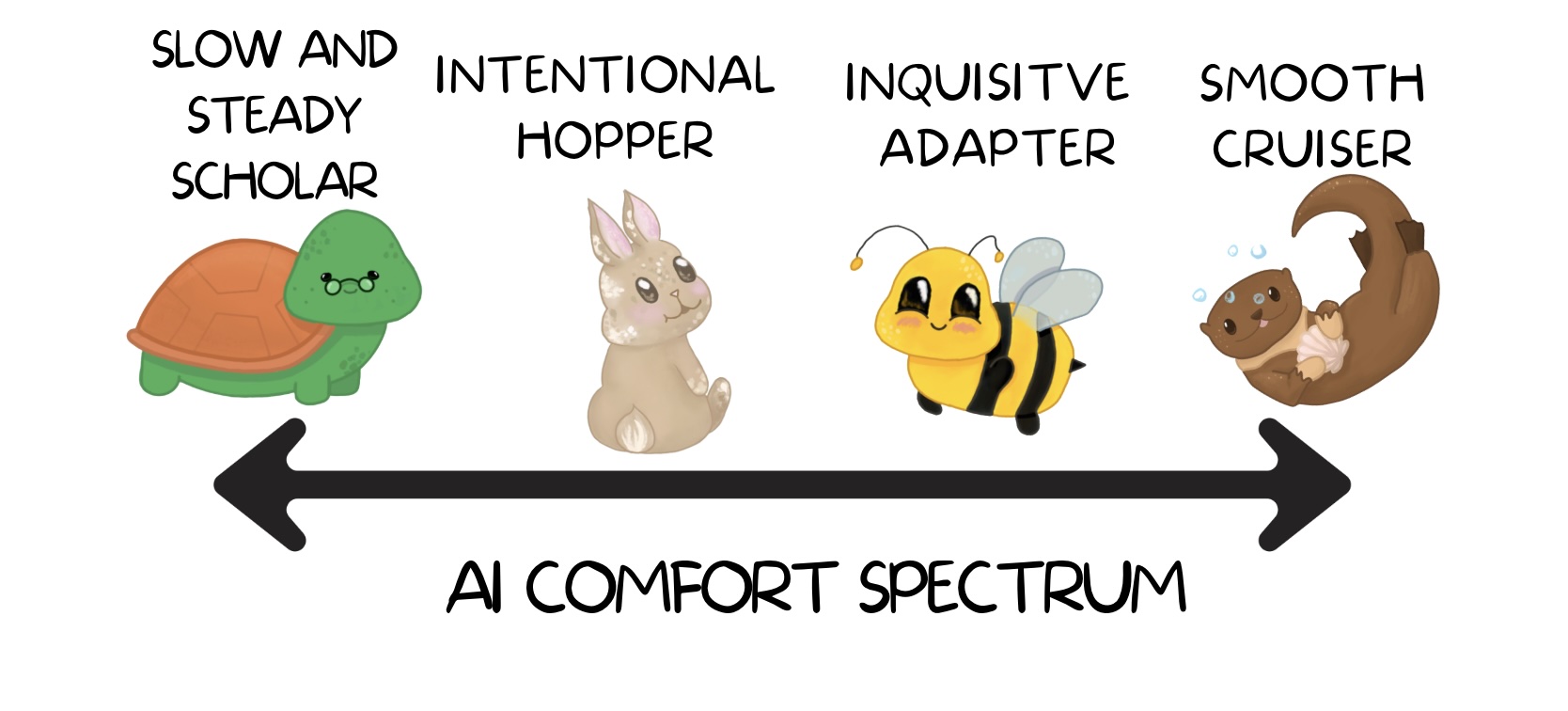 For those who do complete the survey, our project uses four comfort personas, or “sparks:” Traditional Thinker, Puddle Jumper, Curious Explorer and Deep Diver.
These personas are not fixed labels. They function as conversation starters, helping educators reflect on how their comfort with AI may shift depending on context, purpose, role and risk.
For example, an educator may be a Curious Explorer when using AI for their own planning, but a Puddle Jumper when considering student use in graded assignments. The survey helps educators locate their current AI comfort, while the workshop uses those results as a starting point for discussion.
Educator comfort with AI also has direct implications for students. Students are already using genAI, often without structured guidance. If educators feel unable to discuss these tools openly, students may be left to navigate inconsistent expectations on their own, widening inequities in AI literacy when some students receive guidance and others do not.
This is why we are also developing a learner comfort spectrum to sit alongside the educator spectrum. We continue to promote the survey and workshop with educators in different sectors, and are working to bridge our learner-facing survey and workshop to complement the existing educator-facing one.
The two tools are intended to work together: educators can use the educator spectrum to reflect on their own comfort and the learner spectrum to open classroom conversations about students’ AI comfort, discomfort, uncertainty and decision-making. Used together, these can help make AI literacy a shared conversation rather than a one-way lesson about tools.
If Canada’s AI strategy is to build trust in education, AI literacy initiatives need to go beyond technical training and accessing tools. It must encourage educators to reflect on comfort, experiment, ask questions and discuss ethics with peers.
Trust depends on whether educators have the time, language and support to decide when, why and whether AI use is appropriate. Often, individuals who struggle to speak up represent missing voices that are crucial to the conversation. Our workshops suggest that including quieter, more hesitant voices is essential to building trust and creating opportunities as Canada invests in AI literacy adoption across the country.
We hope to continue gathering more insights as we encourage the discussion around comfort and genAI.
Lydia Scholle-Cotton, PhD Candidate, Education, Queen's University, Ontario; Cheryl Lee-Yow, PhD Student in Education, Queen's University, Ontario, and Emily Luo, PhD Student in Education, Queen's University, Ontario
This article is republished from The Conversation under a Creative Commons license. Read the original article.