
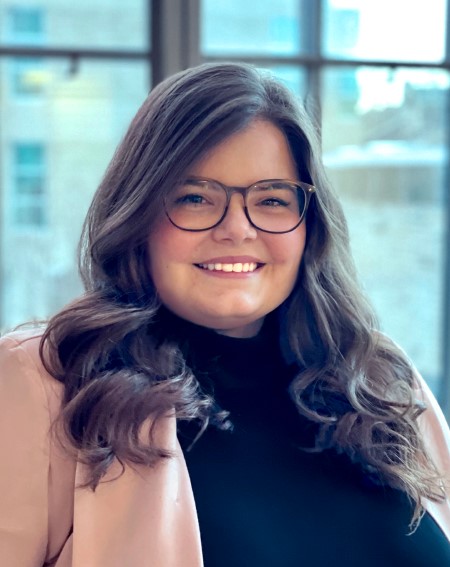
 For Rebecca Leclair, medical education research has always been an important part of her academic trajectory. Now a third-year general surgery resident at Queen’s and a Master of Education student, she is combining her clinical expertise with education to improve how future surgeons are trained.
Rebecca’s journey into education began before medical school. During her undergraduate studies in Health Sciences at McMaster University, she became involved in anatomy education. From dissecting cadaveric specimens as a prosector to being a Teaching Assistant in anatomy and physiology courses, she developed a strong interest in medical education. “Then, when I started medical school, my experience naturally translated into medical education research, which I started doing with Dr. Zevin, who's my current supervisor and one of our attending surgeons,” she explains.
Today, Rebecca is part of the Clinician Investigator Program, a specialized pathway funded by the Royal College of Physicians and Surgeons that allows medical residents to pursue graduate studies alongside their clinical work. For her, pursuing a Master of Education was a practical and meaningful choice. “Since my research is in surgical education, a master's degree in education seemed to be the best fit for me to develop those research skills, which I will take with me when, many years down the road, I become an attending,” she says.
Her experiences as a surgical resident have also shaped how she thinks about teaching. In clinical environments, physicians are often expected to teach without formal training in education. “It’s interesting because there's no formal training on how to teach other people, but educational outcomes in medicine are directly linked to patient outcomes,” Rebecca notes. “As a third-year resident, I've begun to appreciate how difficult it is to teach surgical skills and simultaneously balance everything that happens in the operating room. It's a huge cognitive load, and it’s made me really appreciate how challenging teaching surgery actually is”.
This realization has directly influenced her research. Rebecca is currently working on an innovative project that uses artificial intelligence to support surgical training. In collaboration with the PERK Lab in the School of Computing at Queen’s, she is developing an AI-driven simulation platform for hernia operations, which is a common surgical procedure.
The simulator uses a synthetic model that simulates all the layers of an inguinal hernia, a computer screen with a tutorial for junior residents to follow, and two webcams at different angles that record their performance. As learners perform the procedure, the system analyzes their movements and technique, providing automated feedback. “The idea is to give trainees a way to practice independently while still receiving meaningful assessment,” Rebecca explains. “In our field, time is one of our most precious resources and it’s not always possible to have a faculty member supervising every practice session.” This tool does not replace junior residents’ involvement in real surgeries, but it provides more opportunities to practice those skills without faculty supervision.
Rebecca’s current focus is on validating the system, ensuring that the feedback it provides is accurate, reliable, and truly reflective of surgical skill. It’s a careful and methodical process that will allow surgical students to receive very specific and personalized feedback to support their training.
Looking ahead, Rebecca sees great potential for AI in surgical education and beyond, from improving training to mitigating risks for patients. At the same time, she emphasizes the importance of ethical and thoughtful implementation. “With AI, it’s really important that we don’t just adopt new technologies because they’re exciting,” she says. “We need to make sure we're doing it in a way that is evidence-based, supported by rigorous studies, and that actually benefits learners and patients.”
Rebecca’s time in the Faculty of Education has also offered her a new perspective. After years immersed in medical training, she has found it refreshing to learn in a space dedicated to teaching itself. “It’s a different experience, and it is amazing to see all the cool work that's happening that is not in my own little bubble,” Rebecca highlights.
In the future, Rebecca would like to specialize in hepatobiliary surgery and work in an academic hospital to continue teaching and conducting research. Through her work, Rebecca hopes to contribute to a more thoughtful, evidence-based approach to how surgeons learn and teach.