
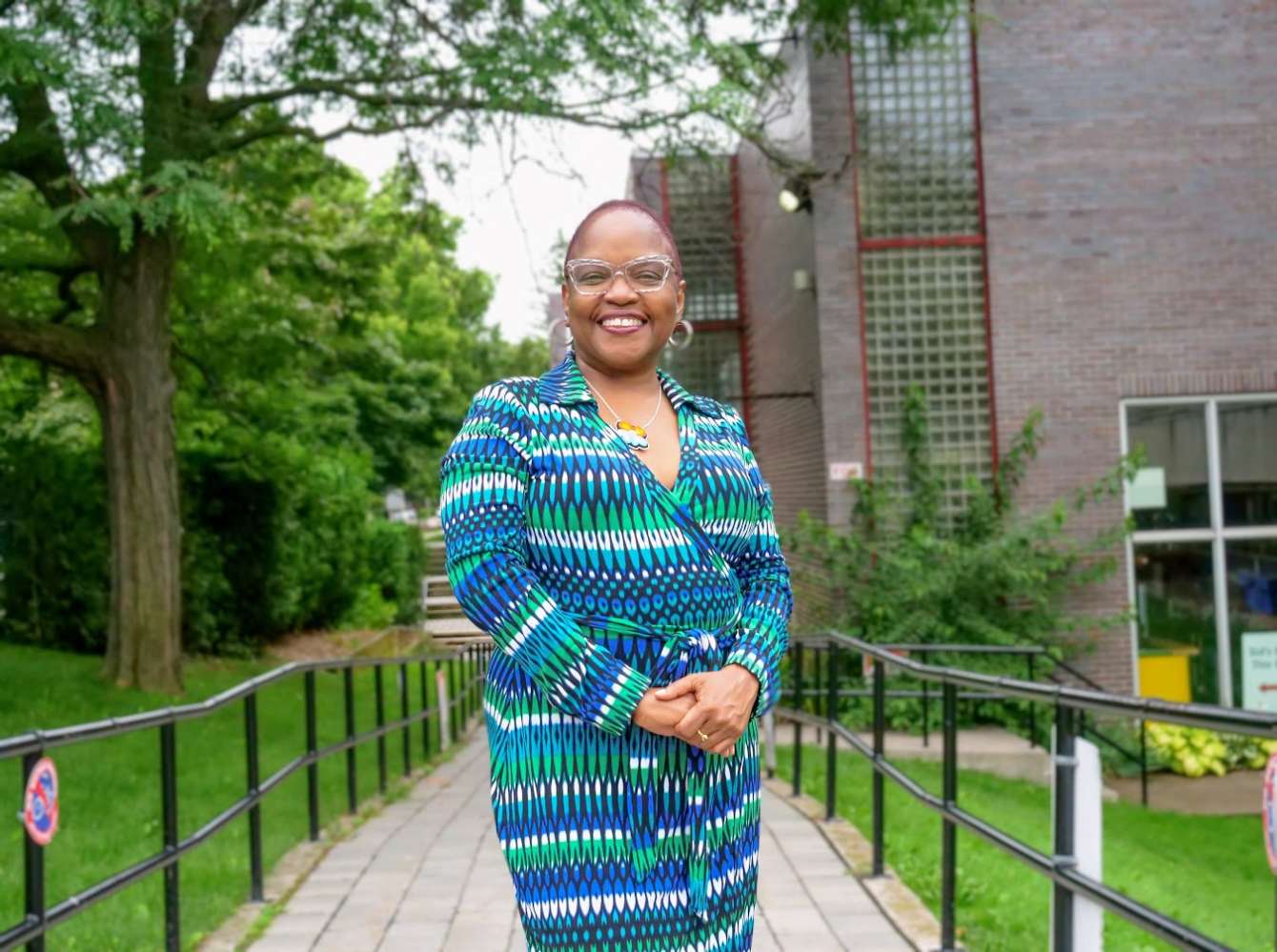
 In this episode of Popular Podagogy, host Chris Carlton speaks with Dr. Jacqui Getfield about what student success really means and how educators can create truly optimized classroom conditions. Drawing on critical race theory and lived experience, Dr. Getfield emphasizes the power of intentional collaboration between home and school, especially for Black, Indigenous, and disabled students.
Read Jacqui's article in The Knowledge Forum, "Black Students in Special Education: Contradiction or Conundrum?"
About Jacqui Getfield
Jacqui Getfield, PhD is founder of a grassroots organization, Mothers United in Mediating Mutual Alliances (MUMMA). Her research focuses on race and disability within family engagement in home-institution partnerships. Her PhD dissertation is titled, “Prescriptive Partnerships: Black Mothers of Disabled Children and Educators in Ontario’s Public School System.” Dr. Getfield theorizes and analyzes through the lens of critical race theory. An adjunct faculty member at York University, she has delivered online public lectures and keynote speeches at universities in Canada and the USA. A diversity, equity, inclusion, accessibility, and belonging (DEIAB) consultant, Dr. Getfield has facilitated DEIAB workshops at charities, non-profit organizations, churches, etc. Dr. Getfield has 25 years of professional experience in education, health, research, and corporate communications in Canada. Currently, she is project manager of the Caribbean African Regenerative Medicine (CARM) project. She is a volunteer board member of the North York Senior Centre (NYSC) and the Black Legal Action Centre (BLAC).
Publications
- Getfield, J. (2025). Riddims and Schisms: Social Construction of Motherhood in Jamaican Dancehall and Reggae Music. In: Podnieks, E., Wahlström Henriksson, H. (eds) The Palgrave Handbook of Parenthood in Popular Culture. Palgrave Macmillan, Cham. https://doi.org/10.1007/978-3-031-94070-5_36
- Getfield, J. (2022). Black Mothering in the Diaspora: Empowerment in the Caribbean Cradle and Resistance in the Canadian Crucible. Journal of the Motherhood Initiative for Research and Community Involvement, 13(2), 18. Retrieved from https://jarm.journals.y
- Getfield, J. (2022). Family Engagement in a Pandemic: Seeing Through a Dark Glass. In K. Fox & L. Szech (Eds.), Handbook of Research on Family Literacy Practices and Home-School Connections (pp. 176-195). IGI Global. https://doi.org/10.4018/978-1-6684-4569-3.ch011
- Getfield, J. (2021). Parenting and schooling in a pandemic (Academia Letters, Article 450). Academia.edu. https://doi.org/10.20935/AL450
Keynote Videos
- Keynote Speech at the York Region District School Board PEAC Symposium 2023
- (M)othering Professionals: Black Mother Dis/engagement, Advocacy and Agency, Public Lecture delivered for TMU in Jan. 2022
Transcript
Theme Song
Talking about innovation in teaching and education. Popular Podagogy.
Chris Carlton
Discussions that are topical and sometimes philosophical. Popular Podagogy. Popular Podagogy. Hi there. Thanks for joining us, and welcome to another episode of Popular Podagogy, where we try to bring big ideas in teaching and education to life. I'm your host, Chris Carlton, and this podcast is being brought to you by the Faculty of Education at Queen's University. Welcome to our podcast. In this episode, I am excited to be speaking with Dr. Jacqui Getfield, who is the founder of the grassroots organization, Mothers United and Mediating Mutual Alliances, or MUMA. As a black mother of twins diagnosed with autism, some of her research focuses on race and disability within family engagement and home-school partnership. Today, we will be talking with Jacqui about student success and optimized classroom conditions. Dr. Jacqui Getfield's PhD dissertation is titled Prescriptive Partnerships: black mothers of disabled children and educators in Ontario's public school system. She theorizes and analyzes through the lens of critical race theory. She has delivered online public lectures at universities in Canada and the United States, and has over 25 years of professional experiences in education, health, research, and corporate communication. A diversity, equity, inclusion, accessibility, and belongings consultant, Dr. Getfield has facilitated workshops at non-profit organizations and churches. Currently, she is project manager of the Caribbean African Regenerative Medicine Project. Jacqui, welcome to our podcast.
Jacqui Getfield
Thank you so very much, Chris. Thank you so very much.
Chris Carlton
I read some of your articles, and the one that really spoke to me was the article entitled Black Students in Special Education: Contradiction or Conundrum? You write, Parents' and families' views and values vary. They often differ from school expectations. And you ask, Is it realistic for families to believe their own lived experiences and cultural identities will be valued in partnership with educators? with whom they must work in the best interest of Ontario's students. And then you go on to say, since student success is the goal for both home and school, educators must not only focus on optimal conditions in the classroom and schools, but they must also ensure there is intentional and collaborative engagement between home and school. And that really spoke to me. And I wanted to start off with the first question. When we talk about supporting student success, what do you think optimized school classroom conditions look like?
Jacqui Getfield
That's a heavy question, Chris, and we're going to get to it. We're going to get to that question, and I am happy that is the excerpt that resonated with you.
Chris Carlton
It did.
Jacqui Getfield
One hand can't clap, Chris. One hand cannot clap. How many hands do you need to clap, Chris?
Chris Carlton
Two.
Jacqui Getfield
How many fingers do you need to snap?
Chris Carlton
Two.
Jacqui Getfield
Nice. We're starting off good. I don't subscribe to low-hanging fruit. So I want not just the parents to be energized, But more importantly, educators, meaning teachers and administrators, the local school and district school boards, must also be energized. I put it to you that educators must be more energized than parents because they are the more powerful. So who am I talking to? I'm talking to teacher candidates who are just thinking about entering the profession. I'm talking to teachers who are in the middle of the struggle, and also those who are at the end of their journey, enjoying the fruits of their labor as teachers who have been in the classroom for decades. And I'm also talking to administrators at both the district school board level And I'm talking to principals and vice principals who are administrators at the local school level. I am talking to them because I don't subscribe to low-hanging fruits. When we want optimized classroom environments and conditions that will yield success for students, We are talking to educators at all levels. And what I'm asking them to do, I'm asking them to take some time out of their busy days and weeks and months and years. I want them to stop. There is an old word. I don't know if anybody uses it in Canada. It's called tarry. I want educators to tarry. tarry for a while so that you can muse. Muse and peruse. I want people to be able to think, think deeply about the problems that exist in public education today so that when you look at the numbers of black and indigenous children and youth who are perpetually numbered, among those at the bottom percentile, you can do something about it because you have thought deeply about the situation. Why are some chronically undereducated? And for whom are we working? And who are we disregarding? Who have we written off, intentionally or not? Some students have been written off. And so after we peruse and muse, and yes, after we tarry, then we must act. We must do something to better the problems for those perpetually at the bottom, supporting student success. and we talk about optimized classroom conditions. Those are heavy concepts. Very, very heavy concepts. So first, let's break it down. What do we mean by student success? Success means different things to different people. Just for parents alone. Some parents view success as academic success. While other parents will say, if my kid comes home and they have not soiled themselves, that is success. For other parents, mental health is extremely important, more important than academic success. So And that's just the parents. Different teachers have different ideas around what success means. I know principals have sat me down and told me why my ideas of success are not necessarily important as far as they are concerned. So everybody has a different idea of student success. That we have to talk about. Home and school must get together and they must talk about it. Because if you're going to support something, you've got to know what you're supporting. And that will then influence what an optimized classroom condition looks like. When we talk about optimized classroom conditions, Ask the parents of your students what do they want for their children. Ask the students what they want from their own education. I believe educators must find ways to ask questions without making parents or families or students feel like they're under interrogation. They must find ways to connect and engage with students and families and caregivers, all of the stakeholders. Talk to them, not just send an email, not just send a text, or worse yet, not just mention it in the school newsletter. All of those things are important for different kinds of messages. But if you really want to connect and engage, with parents, at some point you have to have a conversation. If you don't even have a formal meeting, you have to pick up the phone and call. Open the lines for two-way communication. If I may, I'll just give an example. At Muma, I encourage mothers, yes, and the occasional father, So Muma is an old word for mother. I encourage mothers and the occasional father who perform the mother role to reach out to the school at least three times per year. I encourage these mothers to speak, speak with teachers, speak with administrators. at the local and district school board level as needed. But for heaven's sake, at least three times per year, they should speak with the teachers. I encourage professionals to do their jobs in such a way that they don't leave out parents and caregivers. This is not just a Canadian problem. I speak to parents, mothers abroad as well. This matter of homeschool relation and providing optimal classroom conditions, it transcends Ontario. It transcends Canada. It's a problem in England, in the wider UK. It's a problem in the US. It's a problem with the Caribbean, and it's a problem in certain African countries. I haven't spoken to people across Africa, but, you know, from certain African countries. Parents want to be involved, but parents are usually only involved because they want their kids to do well. Kids can only do well when we have optimized classroom conditions. I'll pause right there.
Chris Carlton
So Jacqui, I've been writing notes here and that's why I've been so quiet. I feel like I'm at a TED Talk right now. So thank you very much for that. And I so agree with everything that you're talking about that conversation and you talked about it takes 2 to clap, to snap, but that open lines of two way communication, making sure that it's not just, I guess, surface so that we do actually talk to the stakeholders, both the parents, the students, and talk about what actual student success looks like for those individuals. And like you said, every parent has a different definition or priority as to what student success means, which is amazing. And that was a very big concept to talk about. You've sort of answered the next question in your conversation there. So from your perspective, what role does intentional collaboration between home and school play in student success? And you've said that. It's so important. It's paramount for student success. And you've briefly touched a little bit about what might that look like in a classroom. So from a teacher's perspective, I do reach out to my parents. I do make sure that they're aware of what's happening. We do an at-home program with regards to when we do experimentation in classrooms and we figure out that home connection with the parents. But is there something else? What else can I be doing in so many different teachers, like you said, both preschool or pre teachers and teachers that have been in the business for a long time, and even those ones that are close to retirement, what other homeschool connections can we really hone in on and make valuable and inroads into student success in general?
Jacqui Getfield
I am glad you asked that, because you know, even though the ministry used to have a document called on parental engagement. I think they took it down. It's now archived. But when I did my dissertation, it was one of the key pieces when I talked about policy. And every time you talk about policy, what you're really talking about, especially when we're looking at a profession, a regulated profession that has its own act, own legislation, what you're really talking about is power. For those of you who have not yet read my dissertation, it is in that. It's a whole section. It talks about the power that educators have. And that's why we have to be careful how much we expect of parents and families and caregivers. So I'm glad you phrased the question like you did. What else can teachers do? Teachers can ensure that what they say they will do they actually do. Let me say that again. Teachers can ensure that what they say they will do, they actually do. They must do it. So, let me be clear. When a teacher designs a Google Classroom and the slides are impeccable, The images are creative. Words are representative. Because, it's all these bullet points kind of thing. It's never full notes. One has to ensure that students are able to understand these symbols, the images. the bulleted points and I'm getting very granular so you understand what I'm saying. Success is individualized because each individual student must make sense of the particular set of Google Slides. If your slide deck is such that students cannot tell or explain to you what's on your slide deck, then you have not yet began to teach. What you have done is designed an attractive slide deck. If you're aiming for student success, if that's the aim, then at the end of the day, You, as a teacher, must be able to demonstrate that you have taught and re-taught as needed by the students in your classroom. I have had situations where, during the pandemic, I have seen where a particular math teacher said to my two boys, when they said that they did not understand something, this math teacher said, I will teach you afterwards. They had a spare period. They didn't take French. I will teach you during this spare period. What does that mean? It means that during the class, for the rest of that class, my two boys were left to their own devices. Total confusion. But I don't believe it's my two boys alone who did not understand. Because I sat there as an observer and I heard another student say, Miss, Miss, I don't understand. And she said, go watch the video again. the video that was placed in the slide deck. And I thought to myself, Isn't that interesting? How does that produce success? How does that beget success? How does that teacher view students who have different degrees of ability. How is content being taught? What are her expectations? Can you tell a lot? I had a lot of questions. I just could not understand how the most powerful person in that room decided that some students were not worthy. If that student did not have the same, let's say, luxury of a spare period, then when would the student have learned the concept that she clearly and bravely said, Miss, I don't understand, only to be shot down and told, go and watch the video again.
Chris Carlton
I think what, and again, I use a program called Stop and Check, which is just making sure of that understanding that you're talking about. But it also comes down to that universal design for learning, multiple means of representation, multiple means of presentation. And so, like you said, that shiny Google slide deck shouldn't be the only course for students because that's just one means of representation. And taking that time, as I'm hearing you say, taking that time, not after class, but during class to make sure everybody is on board and having those conversations with their students. And like you said right at the beginning, slowing down. And I know we have curriculum and I know we have a packed agenda, but just skimming the surface for those students that aren't able to understand it is doing no justice for anyone, because as you mentioned, If one person in the classroom isn't getting it, there's probably a handful of students that aren't getting it. So taking that time, having that opportunity to reteach and make sure everybody is at the same point so that you can continue on, so that frustration doesn't build and that, those are often when behaviors come out when kids are just bored because they have no idea what you're talking or what you're continuing to talk about. So for me, that UDL comes back to mind is we have to make sure that we're reaching all of the kids through different means of representation and presentation, just not one means. Does that make sense from what you're talking about?
Jacqui Getfield
It makes so much sense. But I'm so sorry to say that you're almost a unicorn because I've been through so many, so many meetings with this concept, teaching and reteaching the, as you said, the UDL, there are methods that teachers reject. And it is because, as you said, there is a curriculum. And apparently the speed at which teachers must deliver the curriculum does not necessarily encourage teachers to stop, to muse, to peruse, to think about the students who have been brave enough to put their hands up and risk getting a side eye. You know, the side eyes, Chris. You know, risk being stigmatized, all of that. Only to hear a teacher say, go sit down, go home and go look at the video and don't, essentially don't bother me. Don't bother me. I am teaching.
Chris Carlton
Very deflating for the student, for sure. I will say one thing, Jacqui, that I can tell you, and I'd so invite you to come into one of my classes at the Faculty of Ed here at Queen's, because we really, in my science program and in other programs, we talk about curiosity and wonderment and allowing our students to pause. and go on tangents, go on a different track just because they're curious about it. So we spend time to try to get that deeper understanding and allowing kids to bring in what their influences are from their world into the classroom. So I'm hoping that some of our pre-service teachers are understanding what you're talking about as well in terms of just taking that time to Harry a little bit longer in the subject to make sure everybody's up there.
Jacqui Getfield
Student success in an optimized classroom environment really depends on the will and motivation of the teacher in the classroom. But it also depends on the will and motivation of the teacher to collaborate with parents and caregivers, those in the home. Why is this? Because educators, and in particular teachers, must speak with the student to understand the student, the student's learning needs, why the student behaves the way the student does. And then that educator is equipped to speak with the home. about what needs to happen, what could happen, how they can work together for the betterment of the student. That teacher also should be able to speak with their colleagues, because invariably there are other teachers who may be teaching that same student. Get together, huddle, tarry, Think about what that student needs and how you can truly help that student, how you can advocate on behalf of that student when you go to speak with the administrator. And on the flip side, administrators must give their teachers enough room. They must be gracious enough so that their teachers don't approach them in fear when they're advocating on behalf of a student. The district school board should have some way that both teachers and local principals can approach superintendents and associate directors when it is necessary. to advocate on behalf of students or a student. So the how is also important. When I speak with principals and administrators, because sometimes we do one-on-one, And when I speak with parents in women, in a group, this is what is important, to create open lines of communication where you can speak with each other in a timely manner. Remember, the school term is said to be the school year is a misnomer. The school year is a misnomer. They are in 12 months. By the time you count it may be 10 and then you take out all the different holidays and the different feast days and the different special assemblies, maybe you might get 8 1/2 months of real, clear, direct instruction. But I digress. My point is this. Every situation is different. Every child is different. Some have specific needs that you must address according to their IEPs and their IPRC, you know, the placement. But each student must be considered individually so that we can design optimized conditions for every classroom. There must be intentional collaboration between home and school if you want student success.
Chris Carlton
I will take us right back to the beginning, Jacqui, and say when you talked about it takes 2 hands to snap, two hands to clap, I feel it takes a multitude of hands to clap so that we can make that a roar to produce change in our education system. I have been writing notes like crazy down here. I've already got an invitation for you to come to my classroom, because I think what you're doing is absolutely so important. And I am so excited that you took the time to come and take time out of your busy schedule to talk to us today. And I really appreciate that. Thank you so much for being here.
Jacqui Getfield
Thank you, Chris.
Chris Carlton
That does it for another episode of Popular Podagogy. Again, thank you to our amazing guest educator, Dr. Jacqui Getfield. I hope you take the time to visit our podcast website and view some of the additional information available there. Josh, as always, where can our listeners subscribe to make sure they don't miss any of our Popular Podagogy podcasts? Yeah, if you like what you hear, please subscribe to us on Apple Podcasts, Spotify, the CFRC website, the Faculty of Education website, and pretty much any place you get your podcasts. Please don't forget to check out our Queen's Faculty of Education website and search for popular pedagogy for additional resources. Well, that's it from myself, Chris Carlton, and our incredibly talented and resourceful podcast team of Josh Vine and Erin York. Stay healthy, stay safe, and stay connected, and we will see you next time for another episode of Popular Podagogy.