
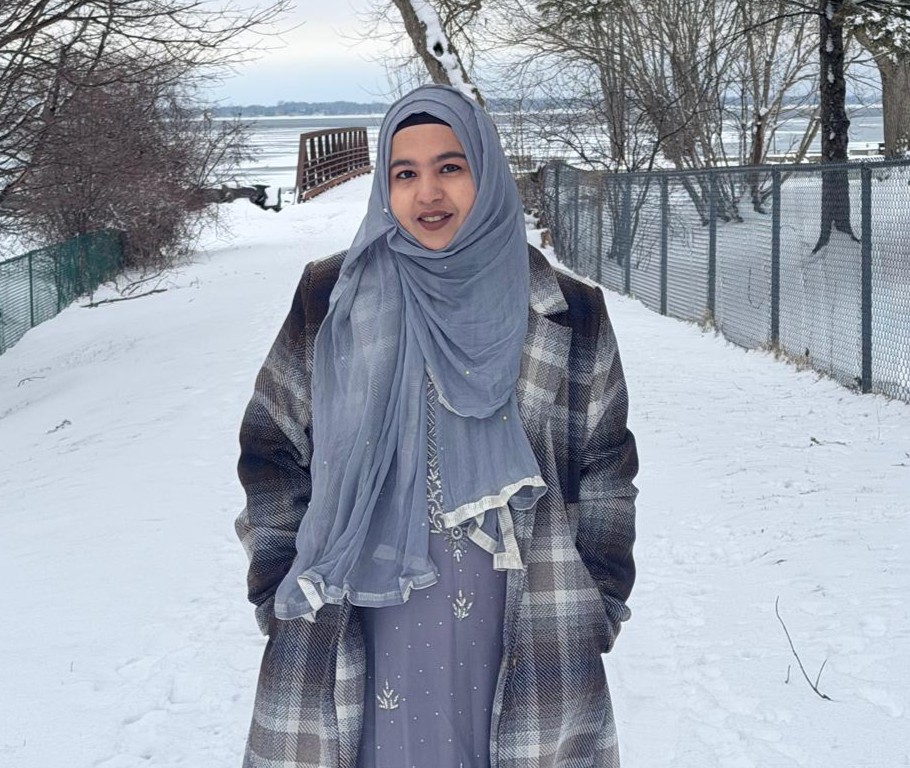
 Naziba Hoque is an international PhD student in Education. She arrived in Canada last August from Bangladesh and is currently finishing the first year of her doctoral studies. For her, pursuing a PhD in Education is more than an academic milestone; it is a deeply personal journey shaped by a profound commitment to raising awareness about the lived experiences of mothers in academia.
Before arriving at Queen’s, Naziba worked for over a decade at a private university in Bangladesh and became an Assistant Professor in 2022. Like many women in academia, she always intended to pursue doctoral studies, but her wish to start a family, and the COVID pandemic, delayed this decision. Nonetheless, her daughter’s early autism diagnosis shifted her priorities. “I knew I needed to begin this journey. Not just for my career, but to better understand what the world could offer to my daughter,” she reflects. That turning point, alongside her own experience as a mother in academia, became the foundation of her research.
A research focus rooted in lived experience
Naziba’s work “The empowerment paradox of working mothers in academia: Examining cultural narratives of care and career in Bangladesh”, examines how cultural expectations, particularly in the Bangladeshi context, pressure women to pursue careers while asking them to be fully responsible for caregiving at home. “In many cases, women are expected to succeed professionally while also doing everything at home” she explains. “It is like women in academia have two separate full-time jobs as mothers and as educators in their workplaces, with minimum support available.”
Her work highlights how institutions often overlook care work, creating hostile environments where mothers must meet the same expectations around productivity, performance, and attendance as men. Through her research, Naziba aims to amplify female voices that are often missing in research.
Mothering versus Motherhood
A key concept in Naziba’s research is the distinction between motherhood and mothering. She describes motherhood as a patriarchal institutionalized set of expectations about what a “good mother” should be while having no structural support. In contrast, mothering is a dynamic, relational, and unique lived experience. “Mothering recognizes that care is not the responsibility of one person alone,” she says. “As the proverb goes, it takes a village to raise a child,” therefore, mothering allows for shared responsibility, both within family and across the community. By centering her research on mothering, Naziba hopes to challenge patriarchal narratives that place unrealistic expectations on women and the stigma associated with working mothers, who are often regarded as selfish and negligent towards their children for pursuing a career.
Bringing disability into the conversation
Naziba’s research also engages with disability studies, in part due to her own experiences as a mother of a child with autism. She explores how disability within families affects care work and often puts even more pressure on mothers. “In Bangladesh, there is a misconception that if mothers devote more time at home, their child’s disability will somehow disappear,” she notes. “But conditions like autism or ADHD are not something that goes away.” Through her work, Naziba aims to promote more informed, compassionate perspectives on disability and care.
Through her research, Naziba hopes to inspire conversations that lead to meaningful change, both within academia and beyond. “I want people to understand that there are options to balance care and career”, she says. “Right now, many women feel like they don’t have a choice. I want to show that they do.”
She will disseminate her findings through digital storytelling, which is a research methodology she has learned from her PhD supervisor, Dr. Patty Douglas. For Naziba, accessibility is vital. In her words, “I want to make my message visible because not everyone will be reading my research. I want my work to reach a wider audience.” Involving participants from the community to share their lived experiences through digital story-making will allow Naziba to achieve that visibility, not only for herself but for the broader community.
By shedding light on mothering experiences, disability, and challenging the stigma associated to working mothers, Naziba Hoque is contributing to a more inclusive and compassionate vision of academic life for women in Bangladesh and the rest of the world.