
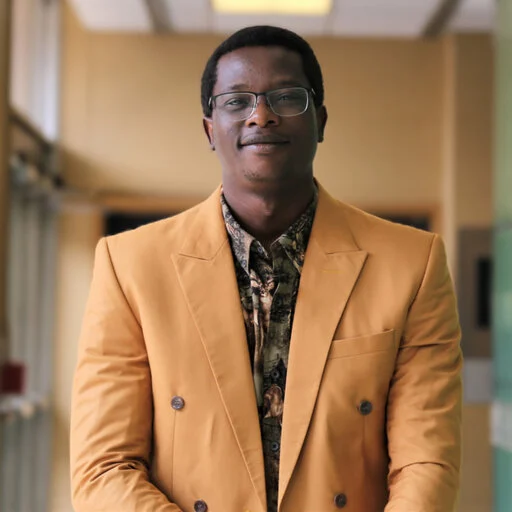
 In this interview, Dr. Ikeoluwapo Baruwa, who recently defended his PhD dissertation, discusses his inspiration for pursuing a doctoral degree, his research on standardized testing versus supporting students in becoming lifelong learners, and his expectations for his new tenure-track position at Canadian Mennonite University. He also offers thoughtful and helpful advice for current and future doctoral students.
What inspired you to pursue a PhD in this field, and what was your doctoral research about?
My biggest inspiration is my faith and my family, especially my mother. One of the deepest motivations behind my PhD journey was seeing my mother’s lifelong desire to pursue advanced education, a dream she was unable to fulfill. I am grateful that she is alive and healthy to witness this moment. I am also the first person in my family to earn a PhD, and I owe much of my perseverance to my family, especially my brother, whom I have always looked up to. I must also deeply appreciate my wife, who has journeyed with me through the demands of doctoral life, understanding both my moments of solitude and the joys that came with this process. Her patience, support, and companionship made this journey lighter and more meaningful. Becoming a professor has long felt like a vocation for me. Even before entering academia, people would jokingly call me “professor,” though I always believed one should grow into such titles rather than assume them prematurely. Initially, I hoped to study law, political science, or philosophy, but life redirected me toward education through the encouragement of my mother and aunt, who is a professor in Nigeria. Looking back, I have never regretted that path. In many ways, education gave me a clearer understanding of what it truly means to teach, think, and contribute meaningfully to society. My doctoral research reflects these convictions.
Broadly, my dissertation argues that universities should focus less on overly standardized measures of success and more on cultivating the intellectual and moral excellences of students. I became increasingly interested in character education and in raising students who genuinely care about truth, knowledge, and understanding, not merely for practical or economic outcomes but as part of who they are. I argue that education should cultivate intellectual virtues such as curiosity, humility, intellectual courage, carefulness, and open-mindedness, helping students become lifelong learners committed to inquiry, reflection, and responsible engagement with the world.
How did your doctoral research and experiences at Queen’s University prepare you for your new role as Assistant Professor at Canadian Mennonite University?
My experience at Queen’s University greatly shaped both my intellectual development and my understanding of academic life. Working within the philosophical tradition in education sometimes meant pursuing questions and approaches that were less conventional in a field often dominated by quantitative and qualitative methods. While I value and appreciate those methodologies, my own work has focused more on philosophical inquiry, liberal education, intellectual virtue, and the purpose of the university itself. Throughout this journey, I was fortunate to have mentors and supporters who believed in my work, especially my supervisor, Dr. David Bakhurst, and committee members such as Dr. Theodore Christou and Dr. Dalitso Ruwe. Their encouragement gave me confidence to pursue questions I cared about, even when they challenged prevailing trends in higher education. I am also appreciative of one of my professors in Nigeria, Professor Chris Omoregie, who, in many ways, helped nurture my intellectual development and created a milieu where I could see university education beyond the narrow emphasis on outcomes and credentials. That experience shaped how I understand the purpose of education today. I also remain deeply appreciative of other faculty members, including Dr. Thashika Pillay and Dr. Alana Butler, whose support made a significant difference during my time at Queen’s. In many ways, I believe my dissertation and philosophy of education align closely with the mission of Canadian Mennonite University. My research asks what education should ultimately aim toward and how universities can cultivate thoughtful, ethically grounded, and intellectually responsible persons. I saw in CMU a community that values those same questions and takes seriously the formative role of education. That alignment is one of the things that excites me most about beginning this next chapter.
What are you most excited about as you begin your tenure-track position, both in terms of teaching and research?
I am excited about the possibilities that come with joining Canadian Mennonite University and becoming part of a new academic community. Relocating to Winnipeg and beginning this new chapter is both humbling and energizing. What excites me most is the opportunity to contribute to a learning environment where teaching and research are deeply connected. As I argue in my dissertation, teaching and research should not be separated into competing activities; they inform and enrich one another. I look forward to helping students engage in learning not only for external outcomes such as credentials or employment, but also for the intrinsic value that learning itself holds. I hope to continue researching questions of existential importance to the university, such as the moral purpose of education, intellectual formation, democratic citizenship, and the cultivation of virtues in contemporary higher education. My work seeks to reimagine the university beyond the narrow managerial and neoliberal shifts that increasingly define it, while also engaging questions of epistemic justice, representation, and cross-cultural understanding so that students from diverse backgrounds can see themselves, their histories, and their ways of knowing meaningfully reflected within educational spaces. Most importantly, I hope to create classroom spaces where students feel encouraged to think critically, ask meaningful questions, and pursue knowledge with curiosity, integrity, and a sense of responsibility to others.
Looking back on your experience as a PhD student, what advice would you give to current graduate students who hope to pursue academic careers?
First, my advice would be to not lose hope. Rejections, disappointments, and moments of uncertainty are part of the journey, but they do not define your future. Sometimes criticism can become an opportunity for growth if we are willing to reflect on it carefully rather than be discouraged by it. A PhD requires more than an intellectual ability. It requires persistence, purpose, and a genuine love for what you are studying. Every student’s journey is different. Some will find mentors immediately, while others may discover support in unexpected places or even outside their departments. It is important not to compare your path to someone else’s. What matters most is not whether one finishes in three, four, or six years, but who one becomes through the process. During my time as a doctoral student, I wore many hats and often worked quietly behind the scenes. I learned the importance of staying focused, setting personal goals, and maintaining discipline even in difficult moments. Academia is fundamentally about engaging ideas openly and thoughtfully, which means being willing to listen to perspectives different from your own while remaining committed to growth. Above all, graduate students should remember to protect their sense of purpose and to keep sight of why they began the journey in the first place.