
Program is contingent on funding and enrolment.
Aanii, Boozhoo, Shé:kon, Tânsi, Wachiya, Kwe Kwe, Bonjour, Hello!
Bachelor of Education, Primary-Junior (JK-6)
In-person
Weekend classes (approximately 10 weekends per year, some weekends including Friday) plus two three-week-long summer sessions in July
Two-year program, starting in May
In six communities across Ontario on weekends & the first July in Kingston, Ontario
The Community-Based Indigenous Teacher Education Program (ITEP) is designed for aspiring educators who want to become certified teachers while staying connected to their communities. Delivered through a flexible blend of weekend classes at community sites and one month of summer learning at Queen's, the program allows you to continue working while earning your Bachelor of Education and specializing in Indigenous education.
You'll build your teaching practice through 18 weeks of practicum in First Nations and provincial schools, learn alongside a supportive cohort, and graduate prepared to make a meaningful impact in classrooms and communities across Ontario. Through a Multi-Session Transitional Certificate of Qualification and Registration (MTCQR), students have an opportunity to complete practicum requirements while continuing to work in teaching positions.
Program highlights
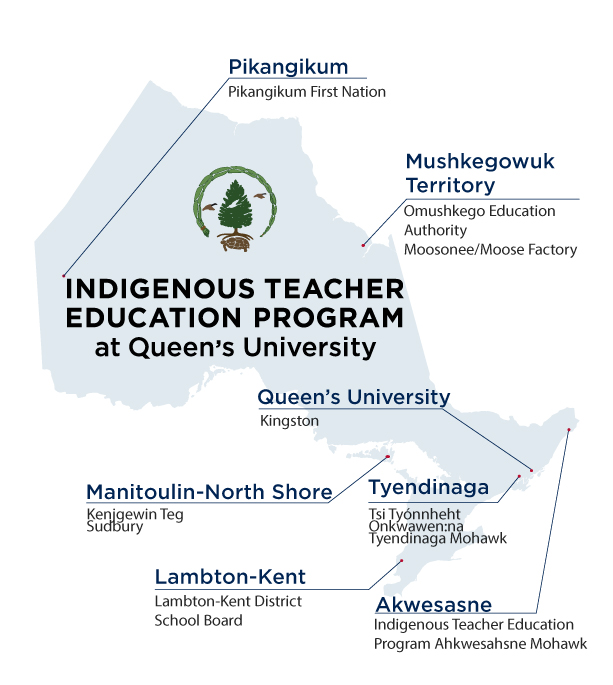
- Become a certified teacher: Our face-to-face courses are delivered over four weekends per term plus in-person sessions for July. Choose one of six community sites for your weekend classes: Akwesasne, Lambton-Kent, Manitoulin-North Shore (Kenjgewin Teg), Mushkegowuk Territory (exact site in Mushkegowuk Territory to be determined based on enrolment), Pikangikum, or Tyendinaga
- Learn & earn: After successful completion of the first practicum and summer session of the program, you will be eligible to apply for the Multi-Session Transitional Certificate of Qualification and Registration (MTCQR), which allows you to complete practicum requirements while teaching in a Primary-Junior classroom that meets the OCT requirements - meaning you can learn and earn at the same time. You can also complete an unpaid practicum placement in a First Nations or Ontario school.
- Flexible admission: Apply with a Grade 12 diploma or equivalent if you are of Indigenous ancestry (PDF 470 KB). Can also be admitted with an undergraduate degree. All candidates receive a Bachelor of Education.
- Hands-on learning: complete 18-weeks of practicum in First Nations and/or Ontario schools.
Please note that weekend classes run Friday-Sunday.
Summer 1 | In-person learning |
|
| Practicum | Three weeks | |
Fall 1 | In-person learning |
|
| Practicum | Three weeks | |
Winter 1 | In-person learning |
|
| Practicum | Four weeks | |
Summer 2 | In-person learning |
|
| Practicum | Four weeks | |
Fall 2 | In-person learning |
|
| Practicum | Four weeks | |
Winter 2 | In-person learning |
|
| Practicum | None |
This is a full-time professional program. Rather than thinking of yourself as a student, think of it as your first year as a teacher.
Our multi-session programs are designed to let you continue working while earning your degree by condensing coursework into intensive learning weekends. Because of the accelerated format, attendance at every weekend is mandatory. Missing a learning weekend may prevent you from successfully completing a course.
Admission Requirements and Information
Without an Undergraduate Degree
Applicants admitted without an undergraduate degree must be of Indigenous ancestry (PDF 470 KB) and submit documentary proof of their ancestry as specified by the Ontario College of Teachers (OCT) when they apply for certification. It is the candidate's responsibility to check the OCT website or contact the College in advance to determine what documentation is required.
With an Undergraduate Degree
If you are of Indigenous ancestry and have a University Degree, you can include transcripts from that degree instead of high school transcripts.
Applicants are required to have an acceptable undergraduate degree (minimum 3-year General degree).
Queen’s University attempts each year to admit a student body reflective of the general population of Canada. The Faculty of Education has developed an admission policy regarding equitable representation of groups that are underrepresented in the teaching profession, and has reserved a number of equity admission places in the Bachelor of Education and Diploma in Education Programs. Those who complete the voluntary Equity Admission form will be considered both under the general admission procedure and under the equity admission policy.
Official Transcripts
- All transcripts submitted must be official, bearing the institutional seal and/or original signature of the institution’s registrar. Photocopied or forwarded transcripts are not acceptable.
- All transcripts, once received, become the property of Student Services and are not returned to you.
- Your previous academic credentials must be obtained at an institution providing an academic environment and education that prepares students for potential success in advanced study at Queen’s.
Out-of-province and high school transcripts are to be sent directly to educstudentservices@queensu.ca or:
Student Services
Faculty of Education, Queen’s University
Duncan McArthur Hall
511 Union Street
Kingston, ON K7M 5R7
Attention: Jamie Kincaid
Official postsecondary transcripts should consist of:
- Postsecondary transcripts from each institution you attended.
- Ontario transcripts: Request your transcript through the TEAS application.
- Out-of-province transcripts: Request transcripts from the issuing postsecondary institution (including CEGEP, if applicable).
Candidates graduating without an undergraduate degree may be limited in the Additional Qualifications/Additional Basic Qualification courses they can take in the future, which can impact your salary. Please see the OCT website for further information.
English is the language of instruction at Queen’s University and in the schools in Ontario where our teacher candidates carry out their required practice teaching. Applicants who are non-native speakers of English are required to provide evidence of oral and written proficiency in English in one of two ways:
- Candidates must have studied full-time at least three full years (or the equivalent) at a university where the language of instruction and examination was in English in a country where one of the official languages is English. Time spent in ESL courses or in an ESL program is not counted toward this three-year requirement. Applicants who have attended university other than in North America must submit a letter directly from the university verifying that the language of instruction and examination was English.
Or
- Candidates must have achieved the required level of proficiency on one of the three tests of English language listed below.
The scores listed below are the minimum English Proficiency requirements for admission to our programs. We strongly advise you to complete your test and submit your scores to us well before the published deadline. It may take several weeks before your test results are released until they reach the Faculty of Education. The only acceptable way to submit your test results to Queen’s University is via the testing body.
To match your results to your application, please ensure that you use the same information as your application for admission to Queen’s. This includes first (given), surname (last/family name), date of birth, and gender. We are unable to match the results received with differing information.
- The Test of English as a Foreign Language Internet-based (TOEFL iBT). The TOEFL iBT test code number 8573 must be used to ensure that the results are forwarded directly to the Faculty of Education. Required test scores: Minimum 24 on the Reading component, 23 on the Listening, 28 on each of the Writing and Speaking components, with a minimum 103 overall. Test results are valid for 2 years.
- The International English Language Testing System (IELTS). Request the Academic test. Required test scores: minimum 6.5 on both the Reading and Listening components, and a minimum of 7.0 on the Writing and Speaking components, with a minimum 7.0 overall. Test results are valid for 2 years.
- Canadian Academic English Language Assessment (CAEL). Select “Test Takers” from the top bar menu to access information, including test locations and dates. Required test score: Minimum 70 in all 4 categories and minimum 70 overall. Test results are valid for 2 years.
Candidates admitted to the program who are found to have an unsatisfactory command of the English language, either spoken or written, where their language skills interferes with their ability to communicate effectively in the classroom, may be required to take remedial work or may be asked to withdraw from the program.
Download a step-by-step guide (PDF, 1148KB) to applying to the ITEP Community-Based programs.
Step 1: Create an account through Teacher Education Application Service (TEAS) and select the correct program code for for Indigenous Teacher Ed Community-Based (P/J).
Program Codes
| Location | Code |
| Akwesasne | Q41 |
| Tyendinaga | Q11 |
| Mushkegowuk Territory | Q13 |
| Manitoulin North Shore | Q14 |
| Lambton-Kent | Q16 |
| Pikangikum | Q40 |
Step 2: Email educmultisessions@queensu.ca with the name and email address used to create the TEAS account to request the Queen's Supplemental fee ($85) to be waived. Do not complete application until confirmation is received that fee has been waived.
Step 3: Login to your OUAC Account to complete the application payment and submit the application.
Step 4: Submit supplemental documents through the Supplemental Documents Form. Make sure you include:
- two reference letters from respected members of your Indigenous community
- a Statement of Indigenous Experience
- a high school transcript
- résumé
Step 5: Wait for an offer of admission.
Supplemental Documents for Indigenous Teacher Education
Submit Documents
Please submit all supplemental documents using the Supplemental Documents Form.
Please note: this form can only be completed once, so please ensure all your documents are finalized and ready for submission. Once documents are submitted, they become property of the Faculty and will not be returned.
Please see our Supplemental Documentation Guide for more details about the process.
| Supplemental Document | Method of Submission |
|---|---|
| Reference letters from two respected members of your Indigenous community (e.g., Elders, Community Leaders, Work Supervisors, Social/School Counsellors, Educators, Director of local Friendship Centres*). The referees must be able to comment on Indigenous community contributions which you have made, and your potential to serve in the field of Indigenous education. *Reference letters cannot be written by relatives or friends of the applicant | Letters of reference should be submitted by the referees directly to: Student Services Office |
| Statement of Indigenous Experience (SIE). Please consider your future in Indigenous education when you are completing the SIE. Personal qualities and experiences are vitally important to the successful educator. The Faculty of Education encourages applicants to focus their SIE on what would make you a good teacher. When listing an extracurricular activity or employment opportunity, describe the impact of this experience and the greatest learning outcome for you from the perspective of how that would make you a good teacher. The readers of your SIE will be looking for you to explain how your experiences will help you as a future educator. | Submit SIE via this form |
| High school transcript showing completion of Ontario Secondary School Diploma. Ontario Secondary School Diploma (Grade 12 Diploma) or GED must be completed by December 1, 2025. | Submit PDF to Supplemental Documents Form |
| A résumé providing a clear and concise overview of both (a) your academic background, and (b) work experience. | Submit PDF to Supplemental Documents Form |
| Applicant information sheet | Fill out via Supplemental Documents Form |
Key Dates and Deadlines
Note: Due to the nature of our program, these deadlines are firm, and extensions will not be granted.
| Key Dates | Description | Method of Submission |
|---|---|---|
| Early Sept. 2026 | Teacher Education Applicant Service (TEAS) online applications open | TEAS |
| Nov. 2, 2026* | Teacher Education Applicant Service (TEAS) online application deadline | TEAS |
| Nov. 10, 2026* | Deadline for receipt of official transcripts and supplemental documents. For policies on transcripts, see TEAS Requirements for Queen's | MyQueens Portal/SOLUS |
| Late Jan, 2027 | Queen's sends first round of offers of admission | TEAS |
| Feb. 15, 2027* | Deadline to accept Queen's offers of admission through TEAS | TEAS |
| June 30, 2027 | Deadline for applicants with conditional offers to submit final transcripts indicating completion of required and/or recommended courses and/or degree conferral | Submit to: Student Services Office |
*IMPORTANT: The deadlines for application, official transcripts, and supplemental document submission are firm, due to the Queen's program starting in May.
Our Program Sites
ITEP Office at Queen's Faculty of Education
educmultisessions@queensu.ca
Akwesasne
AKITEP@queensu.ca
Lambton-Kent
Sarnia, Ontario
LKITEP@queensu.ca
Manitoulin-North Shore
M'Chigeeng First Nation, Ontario
MNSITEP@queensu.ca
Mushkegowuk Territory
James Bay Region
MTITEP@queensu.ca
Pikangikum
Pikangikum First Nation, Ontario
PIKITEP@queensu.ca
Tyendinaga
Tyendinaga, Ontario
TYITEP@queensu.ca
Practicum: Hands-On Classroom Experience
As part of the program, you will complete 18 weeks of in-class practicum in a First Nations school or a publicly funded school, working alongside experienced education professionals. This can be done in two ways:
- As an unpaid practicum placement at a First Nations school or at a publicly funded Ontario school
- As a paid position through the Multi-Session Transitional Certificate of Qualification and Registration (MTCQR)
If you are not eligible for the Multi-Session Transitional Certificate of Qualification and Registration (MTCQR) program, you will complete the practicum component through unpaid placements in First Nations schools or publicly funded Ontario schools. These placements are completed in three or four week-long blocks throughout the program. Wherever possible, we aim to place you within a one-hour drive of your home address.
If you're already teaching Primary-Junior in an eligible Ontario school, you may qualify for the Ontario College of Teachers (OCT) Multi-Session Transitional Certificate of Qualification and Registration (MTCQR). This certificate allows eligible teacher candidates to complete some or all of their practicum requirements while continuing to work in a teaching position.
How it works
- Complete the qualifying practicum - In May of your first year, you'll complete a 15-day introductory practicum. If you're already teaching Primary-Junior in a school, this requirement may be completed through an online module.
- Complete the first term of the program - Attend three weekends of classes in your community (May and June) and the three-week in-person classes in Kingston in July.
- Apply for your Multi-Session Transitional Certificate of Qualification and Registration (MTCQR) - After successfully completing the first term, you may apply to the Ontario College of Teachers (OCT) for your MTCQR. Once approved and employed in an eligible teaching position, you may be able to complete your remaining practicum requirements while you teach.
If you aren't eligible for the Multi-Session Transitional Certificate of Qualification and Registration, you complete an unpaid practicum placement with the support of an Associate Teacher in a First Nations or Ontario school.
Eligible teaching positions must:
- Be in an Ontario Primary-Junior classroom
- Follow the Ontario curriculum
- Include the full responsibilities of classroom teaching
- Be supervised by an OCT-certified principal, vice-principal, or designate who completes your practicum assessments