
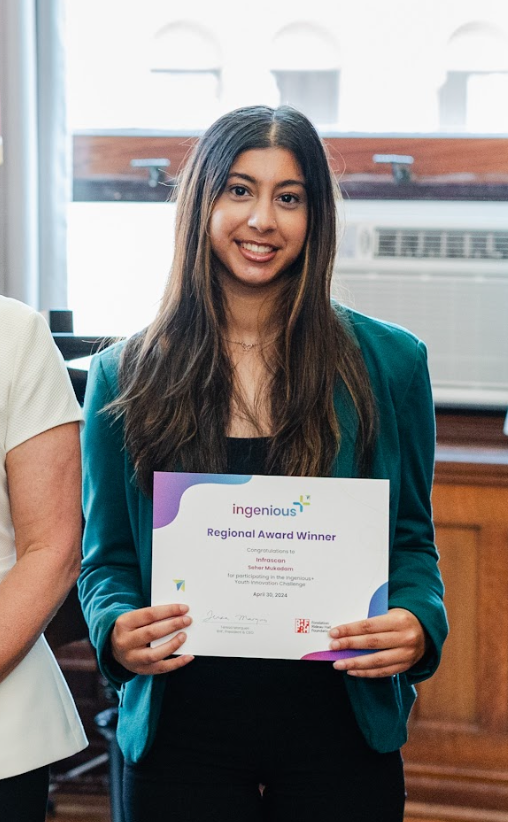
 Seher Mukadam, a first-year undergraduate student in Health Sciences at Queen's University, is spending her summer as a research fellow with the Centre for Community Engagement and Social Change at the Faculty of Education, contributing primarily to the Telling Our Stories project.
What motivated Seher to apply for this fellowship was her passion for meaningful conversations and understanding people’s lived experiences. “I’ve always enjoyed active listening and learning from other people’s stories,” she explained. “There’s so much you can learn from taking the time to understand others’ experiences. It helps you think outside the box and strengthens your empathy.”
The Centre's commitment to highlighting marginalized perspectives particularly resonated with her. Through the Centre’s work with Indigenous autistic youth in the Telling Our Stories project, Seher hopes to expand her understanding of Indigenous worldviews, and approaches to wellness and disability. “I want to learn more about their histories and how they view autism and disease in general,” she said. “I’m really interested in understanding healing practices and the role of elders and community support.” She would also like to expand her knowledge of policy and practice and explore how they can be applied to health and healthcare systems, where she hopes to build her future career.
Although this is Seher’s first formal research experience, she is already discovering how community-based research can create meaningful social change. She describes the fellowship as a “constant learning curve,” especially when it comes to reading systematically, doing scoping reviews, and developing communication skills.
One aspect of the project that especially excites her is the opportunity to directly engage with youth through photovoice methods. Participants are invited to capture images representing what “thriving” means to them. As part of her own onboarding process, Seher did the same activity herself. “It really made me think critically about what makes me feel good in my own life,” she said. “I’m excited to see how their ideas of thriving compare to mine.”
Interestingly, when Seher was a high school student, she created a project encouraging elementary-aged children to paint their ideas and solutions for climate change. The initiative became a small non-profit organization and culminated in a public mural displayed at a fair in her hometown (Cambridge, Ontario). “I wanted people to see the ideas children can give us,” she explained. “Kids have so much creativity and critical thinking, but adults often overlook their perspectives.”
Seher’s commitment to inclusion is also related to her experience working with autistic children at summer camps throughout high school. There, she helped support children in participating fully in programs and activities. “The issue is usually not the person,” she reflected. “It’s the lack of accessibility and flexibility in the environment. Instead of asking how to fix the child, we should ask how we can make spaces easier to access and participate in.”
Looking ahead, Seher hopes to pursue medical school and eventually work with children in healthcare settings. She believes her fellowship experience will shape the kind of healthcare professional she wants to become. “In healthcare, you have to go beyond symptoms and diagnoses,” she said. “You have to listen to people, understand their backgrounds, and consider the social, cultural, emotional, and economic factors affecting their wellbeing.” Her work with the Center will help her better understand how the education and health systems function and how community services can either support people or create barriers for them.
This summer, Seher is also preparing for a family wedding in Zambia, where she hopes to go bungee jumping near Victoria Falls; a great adventure for someone so eager to embrace new perspectives and experiences.