
This is part of a Master of Education research project called Gender in Music Education: Lessons Addressing Gender in Music in Grades K-12 (PDF 4.8 MB) completed by Laura Anne Smith.
At the age of seven, students begin to settle into their gender identity, allowing them to recognize the pressures that exist to act or present a certain way (Canadian Pediatric Society, 2023). Psychology research suggests that students in second grade use selective attention to contribute to a rise in category learning (Sloutsky & Unger, 2023). This means that in order to understand a large influx of information, students create boxes in their heads to help them simplify information and sort it into categories. This can be dangerous from the perspective of gender roles because students will likely add musical instruments and qualities to their simplified categories. This could create social tension for students who do not feel comfortable fitting into expected gender roles because they want the respect of their peers but feel a pull to act on their own identities (Canadian Pediatric Society, 2023). By age seven, children are ready to discuss and understand conversations about sexism, which allows teachers to approach the topic directly (Bear Bergman, 2022). Academics in music stress the importance of gender neutrality in instrumentation in order to allow students to embrace whatever choice feels right to them (Kim, 2022). They also argue for early intervention in order to interrupt children’s overly simple categorization as it is happening (Kim, 2023 ; Sloutsky & Unger, 2023).
This lesson is adapted from a ninth grade instrument selection activity by musician and educator, Emma Barret which was intended for students about to choose their instrument (Barret, N.D.). Students will be asked to come up with qualities that they feel describe each instrument’s sound. The teacher will write the adjectives on the board and facilitate a discussion about how any of the students could have that adjective describe them, no matter their gender. This is to promote gender neutrality in instruments.
Grade 2 - Instrument Qualities
Lesson Objectives
- Students will have their need to place instruments in categories disrupted.
- Students will be able to recognize that perception is different for everyone.
- Students will start to recognize and acknowledge that instruments are not gendered.
Materials
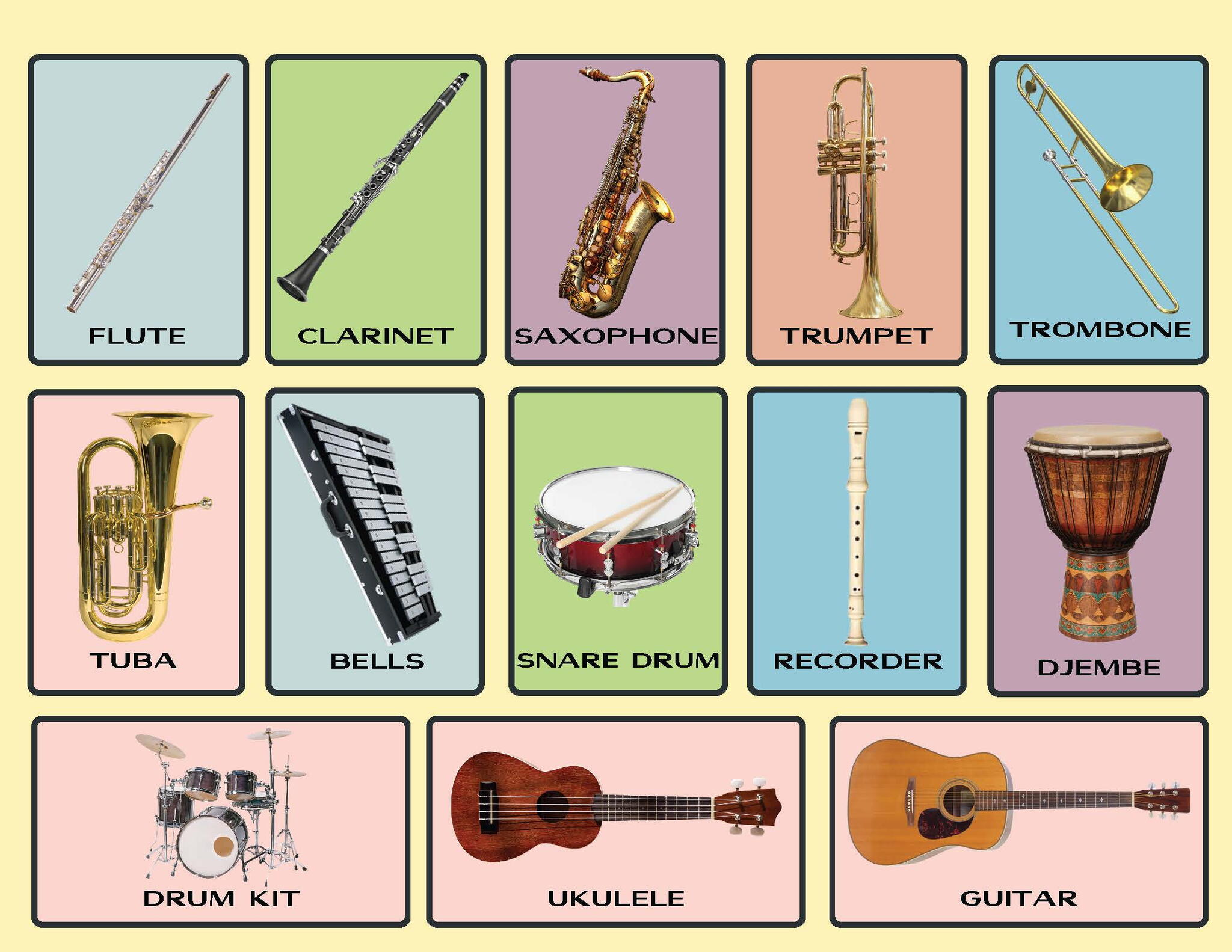
- Instrument poster (PDF 3.28 MB)
- Whiteboard or chalkboard
- Instrument sounds
Activity
- Using the instrument poster, or physical instruments if you have them, introduce students to each instrument and what it is called.
- Play a short clip of the instruments’ sounds using the website above, or your own clips, or play the instruments yourself.
- Ask students to come up with words describing each instrument’s sound and write them on the board under a heading of each instrument’s name. You could also have students do this on a sheet of paper in groups before having them share their responses with you out loud.
- Ask them why they chose those words for each instrument
- If students choose only adjectives that are typically associated with certain genders (assigning the flute as pretty, light, delicate), ask them to explain why they chose the words they did. Then ask if they think it is possible for the instrument to make sounds that could be associated with an opposite adjective. “This time the flute sounded delicate, but do you think the flute can also be strong and powerful?” (The answer is yes: instruments are very versatile and can portray lots of different kinds of feelings and adjectives).
- After doing this for each instrument, erase the instrument names.
- Facilitate a discussion with your students about the groups of adjectives/words on the board. You might use prompts like these:
- Do you see words that describe you?
- Why do you choose those words?
- Encourage answers that aren’t gender-related
- If they say, “because I am a boy/girl…”
- Why do you think those are girl/boy words?
- These words are not words for boys only or girls only.
- Sometimes, boys can be ... and girls can be ....
- You should describe yourself in whatever way feels good for you!
- Emphasize that anyone could be described with any of the words, regardless of their gender.
References:
Bear Bergman, S. (2021, January 4). How to talk to kids about gender: An age-by-age guide. Today’s Parent.
Barret, E. (n.d.). Avoiding gender stereotypes in instrument selection. Bandology.
Canadian Paediatric Society. (2023, June). Gender identity. Caring for Kids.
Kim, S. (2023). Through the lens of Bourdieu: an integral literature review on bringing gender neutrality to the musical instrument selection process. Music Education Research, 25(5), 577–588.
Unger, L., & Sloutsky, V. M. (2023). Category learning is shaped by the multifaceted development of selective attention. Journal of Experimental Psychology, 226(105549).