
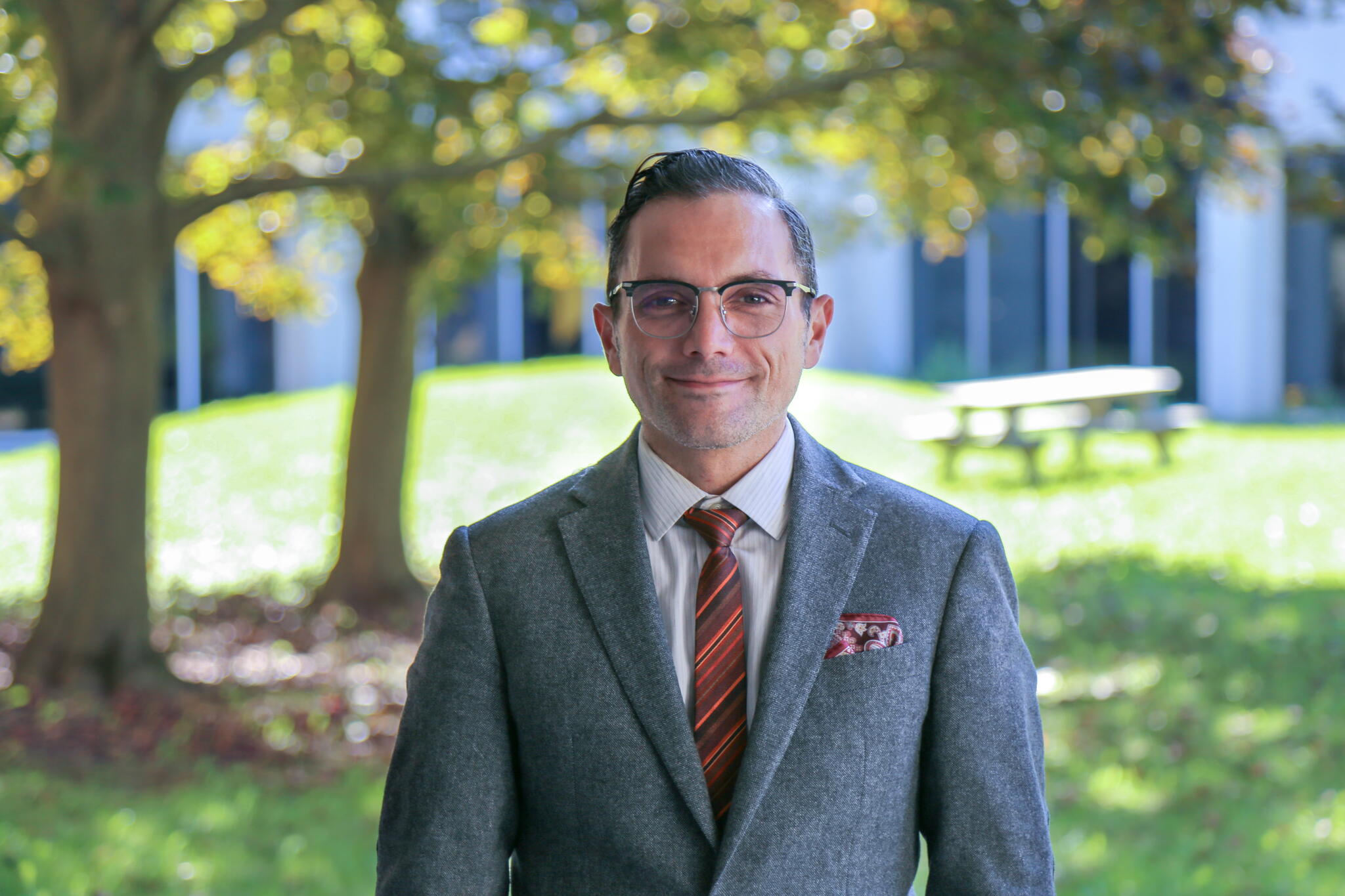
 In this episode, Dr. Theodore Christou, Professor of Education History at Queen’s University, explores the value of field trips and how stepping beyond the traditional classroom can bring curriculum to life. He discusses how experiential learning helps students make real-world connections, build lasting memories, and develop a curiosity that inspires them to keep learning.
Transcript
Chris Carlton
Talking about innovation in teaching and education. Popular Podagogy. Discussions that are topical and sometimes philosophical. Popular Podagogy. Popular Podagogy. Hi there. Thanks for joining us and welcome to another episode of Popular Podagogy, where we try to bring big ideas in teaching and education to life. I'm your host, Chris Carlton, and this podcast is being brought to you by the Faculty of Education at Queen's University. Welcome to our podcast. In this episode, I am excited to be speaking with Dr. Theodore Christou, who is a professor of education history at Queen's University. His academic work centres on the history and philosophy of education, with a particular focus on the evolution of curriculum and pedagogy. And today, we are going to be talking to Ted about field trips, a subject that often automatically brings us memorable moments from our past as students and as teachers. A lifelong educator, Dr. Christou has taught in settings spanning from kindergartens to academic lecture halls and in most spaces in between. He is a member of the Ontario College of Teachers and is a registered early childhood educator. As A 6th grade science teacher, he once participated in Honeywell's Educators in Space program, representing Canada internationally. As A historian, Dr. Christou's research explores the tensions between the progressivism and traditionalism in education. His publications, which include numerous articles and books, examine how ideas of teaching and learning have developed across different periods and contexts. His work seeks to connect historical insights with contemporary debates in education, contributing to a deeper understanding of how education shapes and is shaped by society. Ted, welcome to our podcast.
Theodore Christou
Thank you for having me. It's a pleasure to be here.
Chris Carlton
Ted, one of the many aspects I enjoy about hosting this podcast is the research I get to do on guests that I have the privilege to be talking with. I find out information about people who I thought I knew a bit about, and then as in your case, I'm blown away by all you have accomplished and the accolades you have received for your work in so many different areas. A couple of these revelations that I want to share, and I'm going to quote from the source, says, Theodore is a poet, historian, and philosopher of education. As an interdisciplinary educator scholar, Dr. Christou has edited journals including the Canadian Journal of Education while publishing more than 10 academic books ranging from international handbooks of history to school textbooks used across the province of Ontario. His academic and professional work is rooted in the belief in education's transformational potential and in the articulation of philosophy as a purposeful way of learning in the world. Wow. The things you can learn about people who you see smiling in the halls every single day. Ted, I'm very impressed.
Theodore Christou
Thanks, Chris. It's kind of funny to see your life reflected in a CV or in these kind of quotes, but I'd say my primary identity is always that of a teacher. and even more specifically of an early years teacher. And so the research and the teaching all come from the same place is just, my professional beginnings are as an elementary teacher in Scarborough.
Chris Carlton
That is amazing. And I have so much respect. I have so much respect for teachers as I'm one myself and I know how hard it is. But to be a kindergarten teacher and early educational teacher is something, a special calling that I feel is a few people have that. So congratulations on that. One specific trait that is mentioned in many different comments written about you and I feel relates to our topic of field trips is that, and it says you foster transformative learning environments where learning isn’t really just about memorizing facts or inquiring basic skills, but is more about students making meaning out of their experiences and their interactions with the real world around them, which I believe 100%. So in line with that, my first question would be, what is a field trip? What do you classify as a field trip?
Theodore Christou
Yeah, thanks. I think a field trip, just in short form, I'd think of as an opportunity to step outside of your regular routine or step outside of your indoor space or to step outside of your curriculum as you would follow it normally. And that's very clear and like an old word for field trip is excursion. And excursion is one of these words that we can pull apart because it comes from Latin. And X signals outside, like an exit, points to the outside. And then cursus is like the root is curriculum, which is actually a course that we run or a racetrack in the Latin. And so it's, if we look at the term excursion, it literally is very clear what it is, an opportunity to step off the course or to step with a very clear course in mind off of the course you were already walking on. And so that's an opportunity to mix things up in a way, to change the way you would be teaching and learning in the classroom. And so like in some cases, a field trip is a very specific version of that where you go out into a location. It could be a museum, it could be an art gallery, it could be a site on your school. But it's an opportunity to experience and build a learning experience for your students in a way that maybe they don't get every day.
Chris Carlton
And I love that thinking outside of the classroom walls and like you said, getting outside. And your point was it doesn't have to be a massive field trip. just getting outside into the courtyard, into the play yard, and just experiencing the curriculum in a different way from a different perspective, which I really respect. As a classroom teacher myself, for over 20 years, field trips were always the highlight for my students and for me as a teacher. I would start the year off looking for and planning for as many different opportunities where we as a class could get out of the classroom and as you say, experience and support learning in the real world setting. And looking back on my own elementary and secondary educational experiences as a student, those are the learning events that I remember still to this day. I can see it in my mind. I grew up in a country school and going out into the farmer's field, going out to the local community shops and things like that and experiencing what my teachers were trying to teach us in the classroom. So why do you love field trips as a teacher?
Theodore Christou
I don't think it takes anything away from the day-to-day important work of a classroom to reflect back on my own learning and teaching as a student, but also as a teacher and be unable to remember each and every day. And I don't mean to say that teaching and learning is forgettable, but in some ways it's really hard to remember on January 3rd, or what did I do in 3rd grade? And if we were to each reflect back on what did I learn in 6th grade, odds are there are some things that are not coming to the top of your memory, but there are some things that will, like a project that you did or an opportunity to go on a field trip. Or, and I think this is another part of a field trip or an excursion, is to have a guest speaker or someone and visit your school. Again, it connects that X and the curriculum, the outside and the curriculum. And not only do you go out into the world, but you're bringing the world into your classroom. And that comes from like a very clear orientation to what we do in schools. I've said on a few occasions, Chris, that education is bigger than schools. And what I mean by that is that schools are one of the principal ways in which we do education. but that we don't have a monopoly on it. And so a lot of the work I do in the Faculty of Education is teaching history methods to future secondary history teachers. And there, the idea of a history field trip or bringing in a history, a speaker from a museum or space into your history classroom, I think makes perfect sense with regards to how you would experience history not only as something that relates to the past, but something that we live with today. And there are many institutions, organizations, museums, galleries, community groups, and so on, societies that are responsible in some ways for teaching heritage and history in the communities where we are. And think of the street names where you are. Think of the names of buildings like where we are in Duncan MacArthur Hall. All of these buildings, all of these spaces, Netflix, the news, social media, they're all trying to teach us about history. And so the history teacher or any teacher can't say that they have a monopoly on what students are teaching and learning. And so working with the community outside of the school is I think an essential part of what we're doing is we're building in some ways connections, but also dissolving these very artificial barriers that happen between school learning and life learning. And a second part of that, if I can just keep going, is that in some ways, the way we learn in school is organized by subjects. And subjects don't exist in nature. There are things that we've created to organize a school day and to organize the way we talk about knowledge and the kinds of knowledge that we learn and the way we connect with knowledge and so on. But when you leave the school, you don't say, and now I will do mathematics, and now I will do science, and now I will do social studies, and now I will do science. You live in an organic way through the world. And oftentimes when we step outside of the classroom in an excursion, we're experiencing, we're building experiences for students that are what we call interdisciplinary or in some ways just connected to the ways that students are learning in the real world. And in the real world, not to say that schools aren't the real world, but I mean by that, like the world outside of schools that students will experience outside of that schedule. And the third piece is there that it really is something that I think you're building memories. Teachers put so much into their teaching, so much into their planning. And so you want those lessons to be impactful and you want the kind of experiences that you're building for students to be ones that they can remember and that those experiences open them up to further learning and further experiences. And you've catalyzed in some ways further learning. It is part of what we're doing in covering a curriculum, but really what we're doing is And that's the inspiration part of learning is we're lighting fires. We're seeing education as fire and light. And we're going out and setting, you know, the kind of fires that we want to like set way of inspiring students to want to learn and to feel empowered to learn. And I don't think that happens exclusively through field trips, but I know that there are many students for whom schools are challenging and the ways in which we kind of monolithically learn in schools, like we all learn in kind of the same ways, isn't for everyone. And so field trips give us an opportunity to experience school in a very different way.
Chris Carlton
I want to touch on a couple of points that you just made there, Ted. And I so strongly believe that we need to make learning memorable and impactful And then you added the important fact that sometimes opens up a whole new avenue to further learning where they start to see things from different perspectives, which I think is so, important. The other part that you mentioned was bringing the real world into the classroom. And we're going to talk about sort of the logistics of it, but with Zoom and with Teams and everything we have nowadays as teachers at our disposal, we can bring people from around the world into our classroom and still have that real world connection through guest speakers and representation from across the globe, which is so exciting to me. And I'm sure you probably remember this. I remember it from the original science curriculum document, not the original one, the 2008 one, where in the curriculum document, it talked about who's responsible for student education or student learning. And there's five different things. And one of them, one of the most important was community, making sure that we use them as a partner to help develop the learning of our students. And as you said, getting out into the community, getting out into places where they actually live and play on a daily basis and can actually use what you've taught them in class in real world settings, I think is so, so important.
Theodore Christou
Yeah, I think in some ways, like when I was, and still, but when I was teaching as a public school teacher in the Toronto district, I used to say, that I wasn't so concerned with what I was teaching, like what the curriculum said, but I really was concerned with whatever the students learn, I want them to want to know more about that subject. So like if we're doing baleen whales in 3rd grade or we're doing something around medieval times in social studies or we're learning about something else in literacy, like for me the key was when I'm done teaching that unit or lesson, are the students going to say, I want to forever know more about baleen whales. That was fun. Or like, I learned something really cool today and I did this thing. And then the next time you encounter that subject, I don't know, I feel you're more inclined when you've had a wonderful or dynamic experience around it to want to know more. And part of that is because when we're or the orientation to teaching I have is that what we're doing is often asking questions, not answering them. And inquiry leads us outside of the classroom. Inquiry leads us to even like, as you said, a field trip to our school garden, an excursion to the library with a purpose. And I think that's the difference between just stepping outside the classroom and having an excursion is that it ties to your curriculum. In some ways you're stepping outside of a regular space, but you're also stepping into a new kind of planning. And field trips require tremendous amount of organization because in some ways it's more difficult to collaborate than it is to plan on your own. In some ways it's more difficult to schedule around the availability of buses or even a local site or the school events that you're needing to schedule around, making sure that you have set up that opportunity to be dynamic and in the way, like experiential in a way that, as I mentioned, leads to more experience. And that's the key for an educated experience, I think, is that students want to learn more. They're prepared or excited to continue inquiring. and asking questions.
Chris Carlton
You have a great quote that I'm not going to use right now about subjects, but it's the idea that subjects don't happen in isolation or in silos in real life. They are interdisciplinary. So when I take my students to the grocery store, they can see the science, they can see the math, they can see the language, they can see the geography or social studies, can see the art all in one spot and see those connections you talked about that aren't artificial, that are real world connections that make it more relevant for them and their learning. And as you said, help them want to learn more about it, which is such a rich and I like your ignite the fire and light in education. If we can do that, we are doing so much for our students to make them want to to learn more far beyond what our lessons in the classroom will teach them.
Theodore Christou
Yeah, I appreciate that, Chris. And I think like history of education is actually very useful here. Not only are subjects things that we've created, in some ways they're human made. They're not, you don't go for a walk or a hike in nature through the forest and kick over a log and find literature. That's something that we do. And so when students are stepping outside of that, there's a couple of other things. One is that learning is often dynamic and social. But as I was saying about the history of education is that it clarifies for us sometimes where subjects come from. That's not the case with everything. It's hard to know where English begins or math begins. But social studies, for instance, the subject area that I'm often most involved in, social studies has a birthday. Social studies was born in Ontario in 1937. It was born in Alberta in 1936 and Ontario in 1937 and New Brunswick in 1937. And it had a distinct purpose. And the purpose in some ways was to integrate learning and focus it on experiences. It comes from a very progressive orientation to getting students to pay attention to the world as it is. And so much of what progressive education would have criticized historically is a focus on schooling that was considered passive, where you're sitting and you're reading and you're memorizing, and then you're writing an exam or a test that gives you that content. You finish that test, you walk outside of school and a friend says, what was on that test? And you say, I don't know, I've forgotten it already. Like it's already gone. Like it's, I just, I remembered it just long enough to get it down on the test. Now that's a kind of learning and it's a way of measuring learning, I guess. But then there's a different way that's connected to an orientation that schools ought to pay more attention to the world as it is, and that students' preparation to engage with the world is partly how we engage with the world in schools. John Dewey said that schools aren't preparation for living, they are life itself. And he also called them a form of associated living. And if we take that legitimately, then again, the idea of an excursion, the idea of taking the students outside of the textbook or outside of the desks, outside of the carpets, outside of the technology that you have in the classroom, outside of the kind of spaces and conversations confined by that, you have different learning experiences and oftentimes they are social and often they are dynamic and oftentimes they do relate to the world as it is. And then that's the last piece is that students who go on a field trip to, let's say, Fort Henry in Kingston, Ontario, while they're learning about the War of 1812, can get a whole other experience with each other that gives them a kind of a lifelong memory to build on, which is in its qualities very different from the kinds of learning you'd get in the classroom.
Chris Carlton
I like that shared experience with each other because that's that common shared experience that you can have a discussion about and learn from everybody's perspectives. I've started a Ted's Tidbits list here. And so I added, I love this one, subjects are human made. And I hadn't thought of that before, but it's so true. That's not how they occur in real life. So if we love field trips and we know how exciting and valuable of a learning experience they can be, why don't we do more of them? What are some of the challenges or logistics of planning field trips?
Theodore Christou
I think sometimes teachers are doing field trips, but maybe not thinking of them as such because you're not filling out a field trip form and going through the paperwork that you might need to do so for the school board or for security and safety of the students. So the first thing I'd say is that I think teachers and students are already doing all kinds of really cool learning that steps outside of the classroom. We're not necessarily calling it an excursion. But let's say you are doing research on a particular subject or you have the opportunity to get the students to choose a research topic and you go to the library with a purpose and the students are choosing something that's going to become foundational to them or you've given them a task like find the oldest book in the library. I don't know, something like that. Then that becomes an educational experience that's happening in your school. And I've made-up two sample examples here, but there's teachers are far more creative than I am and probably are doing all kinds of really cool things. So I'd say the first thing is that teachers and students are already, I think, seeing the value of field trips and doing those. But there are other challenges that make it sometimes the larger, more structured field trips that may come to mind more challenging. It may be the cost of going to the location. It may be the logistics of organizing transportation. It may be the organizing of parents and community to come along as chauffeurs. Let's say there's a ratio that the school board needs of having three or four adults for every X number of students. These are obstacles, but they're also in some ways real opportunities for a teacher to do these connections. So it's an opportunity for you to connect to the people in your community, to connect to those institutions and organizations and societies and galleries and museums, et cetera, that are responsible for the kinds of learning you want to engage with or house the kinds of materials you want to engage your students with. And so that's an ongoing thing. you're always connected and your role as a teacher is to figure out where I am, what are those museums, what are those institutions? But then also it's a responsibility that we get to know the parents of our and the community beyond this. And so when if the first time you're connecting to your parents in your classroom, the parents of the children is when you have a need for field trip chauffeurs, then that's good that that's given you an opportunity to reach out with the parents, but that shouldn't be the first opportunity you're doing that. And so like the idea of planning for a field trip is in some ways planning for teaching as part of a community. And so I get to know the parents, I get to know what are those sites in my community that I can connect, who are those people that I can connect with? And then there's some of the other logistics and I think that a lot of those, it's difficult to speak about like in a, from where the vantage point I'm in, but if I were in a school and starting in a new classroom, one of the first places I'd begin is with my colleagues and I would find out where teachers are already going on. What did you do as an excursion last year? Who were the guest speakers that you brought in? What were the experiences you tried to build, even if you haven't called them field trips? Like what are those kinds of experiences that matter to students? And do you want to partner on some of these? This is my first one. Do you want to do a field trip together? Or can I see the documents that you submitted last year? Or you can go to your principal or vice principal and get the documents in advance so you can see, okay, I need to have buses to do this trip properly. And so that means I need to think about the budget and I need to think about other things. And it may be that field trip that you have in your mind is the perfect field trip isn't logistically possible. But that gives you then ideas for how what is logistically possible. if I'm teaching grade 10 ancient civilization and I'm teaching about ancient Greece and Rome or democracy in Athens, and I think, what would be really great is if I can take these kids to Athens and, we can have a hero underneath the sun and feel the dust and the heat and walk these steps and we'd be able to have a different understanding of what it meant to be a citizen. Okay, that might not be possible. Maybe it is, but maybe it's not. And so that's you mentioned technology. There's all kinds you can do. You can do 3D tours of Constantinople as it looked at in, you know, the 11th century virtually. You can do all kinds of opportunities to bring in a curator from a museum in Athens or classes that could talk, or you could build an experience in through that collaborative space. And so I think it really comes back to the purposes. And when you said you were a teacher, Chris, and we were like thinking of all the field trips you could do, you were really thinking of how do I sequence learning as a set of experiences? not as like checking off content as I go, but building from one experience to the next. And I think when you're doing that, then the planning if thinking of the community, it also requires that we begin planning right at the beginning. When you're thinking of the curriculum, you're thinking about how to bring it to life. You're thinking about who can partner with you in the school and outside the school to make it dynamic for the students and purposeful. And what kind of experiences would turn them on to more learning. And and what you can do realistically in the classroom and what you can't do. I'm talking a lot here, but I think that actually comes down to like a sense of modesty in teachers. It's not easy to realize or to state that I can't do this all on my own. teaching ancient Greece needs a community. And so I can do a part of it, but I need others to make that happen with me. And so I think that's one of the ways I've answered maybe your question, I hope, about like where do you begin and why is it so challenging? I think part of it is like we don't name everything we do a field trip that could be named like an excursion. I think this movement in and out of the school is part of what I'm talking about. And that field trip to Fort Henry is an example of what that is, what an excursion could be. But also that we ought to realize that we can't do this job on our own and require others. And requiring others means planning experiences with others in and outside the school. So there are certainly logistical steps depending on the scale of the field trip you want to and the ambition you have. But that some field trips might be more difficult doesn't mean that you shouldn't be doing that kind of experiential learning with your students in whatever capacity you can. Even if you don't actually leave the school grounds, you can still build excursions.
Chris Carlton
And I think the one point that really hit home with me is those opportunities you mentioned, the opportunities for connections. And connections are really important for my teaching pedagogy, but the connections with the students, the connections with the parents, with other teachers, with the community, with experts around the world. And I really feel we live in an amazing age where we can, like you said, zoom in somebody from across the globe that is an expert, that is living that so that even if it's not something that's feasible financially or logistically, we can take them there through technology, which to me is just brilliant. And I like your phrase, how do we bring curriculum to life? And to me, that also involves student voice, student choice. You talked about that. What are they interested in? What are they excited in? And how do we create that environment that they just want to learn more and continue to learn more? I have the privilege of working with teacher candidates here at Queen's, and we talk a lot about the importance of getting outside of the classroom and allowing those real world experiences to support and enhance the classroom lessons. But as we're having those discussions, and you have answered this a little bit, so we'll touch on it quickly, As I'm having those discussions with my students, I will see some of the teachers nodding their heads and ready for those types of educational adventures. But there are also some new teachers that are feeling overwhelmed with the idea of taking their students outside the safety and comfort of the classroom. And you touched on one, so I asked, what are some of the steps? You touched on the fact that just partner up with somebody, somebody that's already doing it. My first overnight field trip was a three day overnight and it just, I was really nervous about it, but I was part of a teaching team that they had done it for so many years and I was able to ride alongside of them and learn it until the point where is that I took it over as part of my learning experience for newer teachers. So going up beside somebody you talked about, it doesn't have to be this exhaustive field trip. It can be outdoors. It can be right out in your yard. Try something small first to get your feet wet and then realize how much power it has for you and your students. Is there anything else that would like first steps for teachers to help them feel more comfortable with field trips?
Theodore Christou
I think you've touched on some of the important ones, but I think just to clarify maybe that second one rather than add a new one is that I would take it in steps. Do what you're comfortable with. But I think I think it's important to remind teacher candidates of the importance of bringing a curriculum to life and the kind of story that we're telling as teachers in some ways. We're narrating in some ways the curriculum in the same way a storyteller might. But we're also, as you said, working with the students and their interests and capacities. And so it may be that you haven't thought of a field trip as something that could, and it's in the middle of teaching something that you're like, oh, there was an opportunity. Let's say I'm reading Romeo and Juliet in Toronto and one of the high schools is staging that. or another play. I missed that this year. So next year, maybe I'll pay attention to some of the opportunities in the school board I'm teaching in to be able to go to another school or to find these networks and connections. Another opportunity, Chris, that I think of is to use the opportunities that we have for professional development to build the professional network that you have and to see other teachers as colleagues who you could do field trips with. They may not be at your school. They may be at another school. They may be in another school board. So I think having these kinds of conversations and if you're feeling uncomfortable with field trips, starting to build either beginning with very small field trips and seeing how that experience works and the kinds of supports you might need and just being reflective and as I've mentioned I think before, being humble about where you are. All of us as teachers, whatever, wherever we are on the continuum, are always continuing to learn about how to do our work, how to inspire, how to bring learning to life in different ways. And that evolves in many different ways. And I think it's very natural for a young teacher or a new teacher to feel that that seems like a whole other wrinkle to what I'm doing. And I think what I'd say is that it's not. It is what you're doing. And what you're doing all the time as a teacher is not closing the door of your classroom and shutting out the world, because that's not possible. You're not the only one teaching that subject. You're not the only one in the student's life that is or in their community that could do that. And so as we're getting more comfortable with our professional growth, I think part of that is setting a professional development plan maybe that involves more engagement with the community and then having a conversation with your administrator or colleagues about how to pursue that. It doesn't necessarily have to be a goal that you begin to stress about. It is really about remembering not only that the students are having an incredible, can have an incredible amount of fun and learning experiences, but the teachers do as well. One of the reasons I do field trips is because I enjoy them. I enjoy stepping out of the classroom with my students and watching them learn while they're in a historic site. I enjoy myself taking a break from the routine of what I am doing to mix it up in my own the narrative that I'm telling in the classroom. And so I think it in some ways is also good for the teacher to be able to break up a routine that we can get really habituated to and stuck in some ways.
Chris Carlton
I love those opportunities when we see the light bulb go off in a student's mind when they see something in real world that we've talked about in the classroom and they make that connection. They see that relevancy and you can see it in their faces. And as you said, it's the teacher joy to be able to see that. And that also is one of the things that I love about field trips. Ted, I'm going to leave us with this final Ted tidbit. And it is what you said, through field trips, teachers can help narrate the curriculum and make it come alive and relevant to our students. And I think that is such an important message. And for those teachers who already love field trips, it's sort of supporting them. And for the teachers that need that little extra help, find that connection, find somebody that's already doing it. Like you said, there's so many teachers doing wonderful things that we can ride on their coattails for a while until we feel comfortable enough doing it on our own and then help other people get there as well. Dad, this has been an exciting conversation for me. I absolutely love talking about field trips and it was great getting to know you and know about your teaching philosophy through this podcast. Thank you so much for joining us today.
Theodore Christou
Thank you, Chris. Thanks for the chance to speak. I've enjoyed the time with you as well.
Chris Carlton
That does it for another episode of Popular Podagogy. Again, thank you to Dr. Theodore Christou. I hope you take the time to visit our podcast website and view some of the additional information available there. Josh, as always, where can our listeners subscribe to make sure they don't miss any of our Popular Podagogy podcasts?
Theodore Christou
If you like what you hear, please subscribe to us on Apple Podcasts, Spotify, the CFRC website, the Faculty of Education website, and pretty much any place you get your podcasts.
Chris Carlton
Please don't forget to check out our Queen's Faculty of Education website and search for popular podagogy for additional resources. Well, that's it from myself, Chris Carlton, and our incredibly talented and resourceful podcast team of Josh Vine and Erin York. Stay healthy, stay safe, and stay connected. And we will see you next time for another episode of Popular Podagogy.