
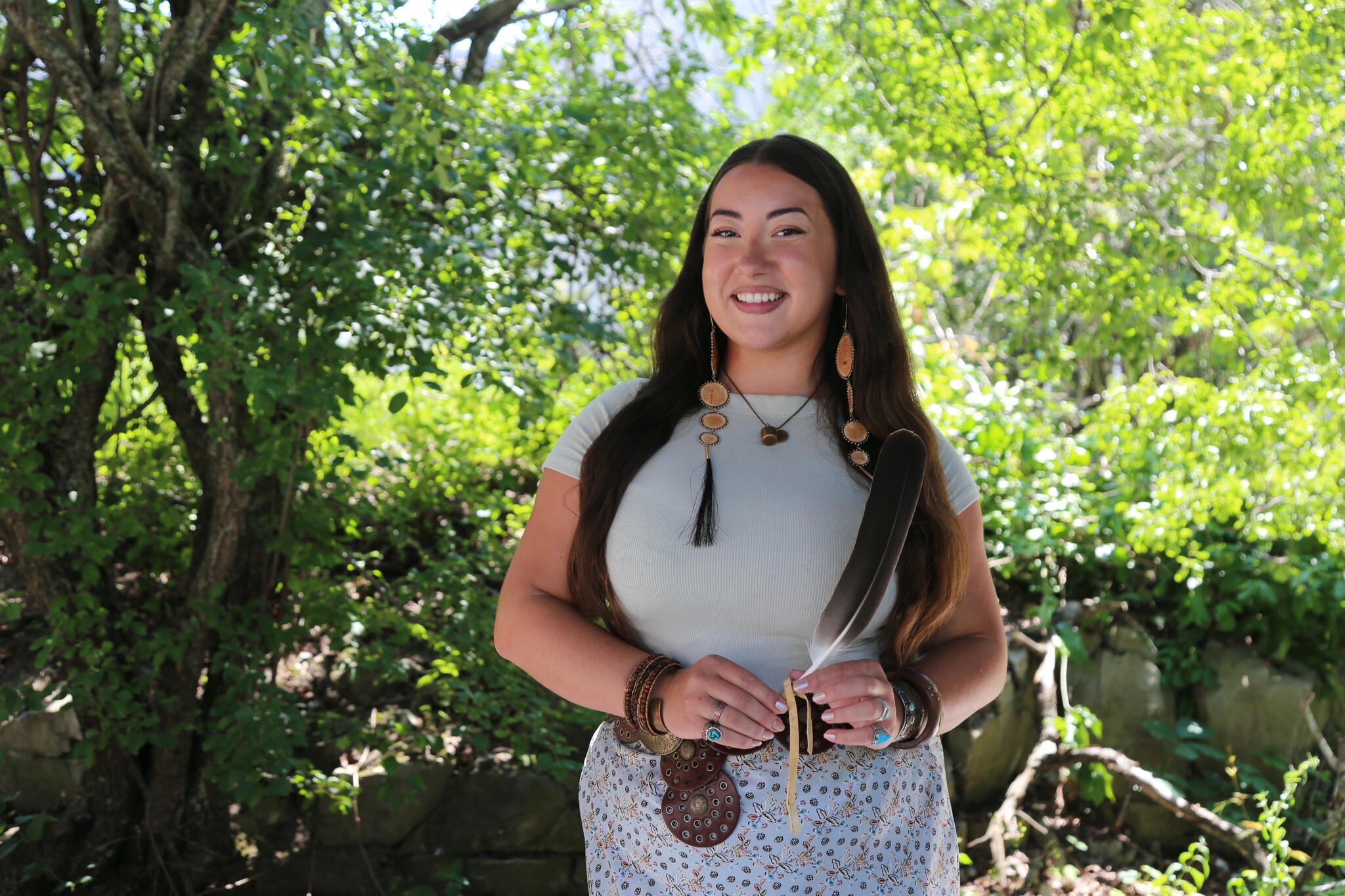
 Mskominkwe (Reagan) Recollet, a teacher candidate from Wiikwemkoong Unceded Territory on Mnidoo Mnis, commonly known in English as Manitoulin Island, is on track to become a fourth-generation Anishinaabe educator. Her great-grandmother, grandfather, and mother all worked as teachers. Now, through Queen University’s Indigenous Teacher Education Program (ITEP), she's carrying that legacy forward.
"My great-grandma Louise Peltier attended Spanish Indian Residential School, where so many of our relatives around Robinson Huron Treaty territory were sent against their will," Mskominkwe explains. "Almost instantly, after getting out of that assimilatory institution, she went to Lakehead to become a teacher. My grandpa, George Trudeau, did the same through Lakehead University’s Anishinaabe Teacher Program, and then my mom, Miranda Recollet, became a teacher too through the University of Alberta. It just feels natural and equally necessary for me to follow this path.”
What makes Mskominkwe's experience different is that she doesn't have to leave the community that shaped her. Thanks to Queen's community-based delivery model and its partnership with Kenjgewin Teg on Manitoulin Island, she can continue working as a Teaching Assistant at Lakeview Elementary School in her sister community of M’Chigeeng First Nation while earning her Bachelor of Education.
"Had they not partnered with Kenjgewin Teg, there's no way I would have been able to attend Queen's," she says. "I can continue serving my community while getting my education. I don't feel I have to reconcile beyond my ability and surrender parts of my identity that are so integral to who I am. I'm able to fulfill my obligations to home while building my future, and until recently that has been entirely unprecedented."
That connection to community is exactly what drew her to teaching in the first place. "We know the future needs educators who reflect the communities they're serving," she says. "I see a real opportunity to build on what my family started while meeting the ever-evolving need for connected Indigenous educators."
Having spent years working in First Nations schools, Mskominkwe has seen firsthand how meaningful it is when Indigenous students see themselves reflected in their teachers.
"I love being able to bring our pride, our sovereignty, our language, and our ways of being into the classroom," she says. "When kids see that the authenticity in our culture is accessible, it's incredibly transformative. I'm overjoyed that my students see themselves in me."
While she has worked with students from preschool through Grade 8, Mskominkwe admits her heart keeps pulling her back to the youngest learners. "I always leave after a day with kindergarten or Grade 1 feeling so uplifted and far lighter than when the day first began," she laughs. "We always say teachers learn as much from students as students learn from us, and I truly believe that. They're constantly reminding us of the values we sometimes lose along the way as adults."
Indigenous Teacher Education Program Community-Based students spend three weeks of their first summer in Kingston on Queen’s campus. This provides an opportunity for students from all six of the ITEP sites to meet and learn from each other.
"The relationships we've built here are so special," she says. "We're all coming from different Nations and vastly different communities; through our time on campus, we are learning from one another every day. Between classes, we’ll spend time comparing words in our languages and sharing stories from our homes. It’s overwhelmingly clear that across this ITEP cohort, we strongly believe our vibrancy as Indigenous peoples deserves to be at the forefront of our teachership”
Being together at Queen's carries a deeper meaning, too. "We laugh sometimes about how none of the people who founded Queen’s University in 1841 would have imagined we'd all be here and having the critical discussions we are contributing to," she says. "Although bittersweet, there's something powerful about being unapologetically Indigenous in this space that was entirely built and developed without us in mind. Even beyond that, Indigenous peoples were intended to be excluded from academic spaces of learning and prestige in colonial perpetuity. Being an Indigenous teacher candidate means redefining, reclaiming, and revitalizing education, including the institutions and systemic infrastructure on which it depends. Above all, it centers on the importance of community, which we have all gained through the Indigenous Teacher Education Program.”
For Mskominkwe Recollet, becoming a teacher is about honouring those who came before her while helping create a future where Indigenous students can see themselves, their cultures, their sovereignty, and their communities reflected every day.