
The recent changes to teacher education announced by the Ministry of Education will affect the information found on this page. Updates will be made as details are confirmed.
If you’re a practicing artist—whether in visual art, music, drama, dance, film, or creative writing—the Artist in Community Education (ACE) program is your pathway to becoming a certified teacher in Ontario.
In ACE, you’ll explore arts-based teaching methodologies through hands-on, immersive activities. While you’ll build on your own artistic expertise, you’ll also be encouraged to step outside your primary discipline—experimenting with other art forms to deepen your understanding of the full creative spectrum.
This cross-disciplinary approach connects all forms of art through shared principles of creativity, aesthetics, and expression—equipping you to inspire students in classrooms, community programs, and beyond.
Application Process
Selection of incoming teacher candidates is based on the Queen's application requirements as well as the supplemental documents (portfolio and art resume) submitted to Student Services. Applicants must meet the requirements for Primary-Junior or Intermediate-Senior.
Concurrent Education teacher candidates can apply in December before entering their final year.
Overview
- You will pick teaching divisions: Primary-Junior (JK - Grade 6) or Intermediate-Senior (Grades 7 - 12)
- Our condensed program is 4 consecutive terms, starting in May and ending in August the following year. This means you can start your career a year earlier than most other programs.
- You complete 21 weeks of practicum: 18 weeks in a traditional school setting and three weeks in an alternative practicum that occurs outside of a school setting and can happen anywhere in the world. You are able to apply for a travel fellowship to support travel outside of Canada.
- Emphasis is on learning from one another and exploring the positive role that artists and the arts play in our schools, our communities, and our society.
- The ACE class is a small, select group where you collaborate closely, building strong personal and professional connections that last well beyond graduation.
Program Schedule
|
Summer 1 (May-Aug.) |
In-person learning |
|
|
Practicum |
3 weeks Practicum (May) |
|
|
Fall 1 (Sept. – Dec.) |
In-person learning |
|
|
Practicum |
7 weeks of Practicum (Oct. – Nov.) |
|
|
Winter 1 (Jan. – April) |
In-person learning |
|
|
Practicum |
4 weeks Practicum (Feb. – March) 3 weeks Alternative Practicum (March) |
|
|
Summer 2 (May – Aug.) |
In-person learning |
|
|
Practicum |
4 weeks Practicum (May) |
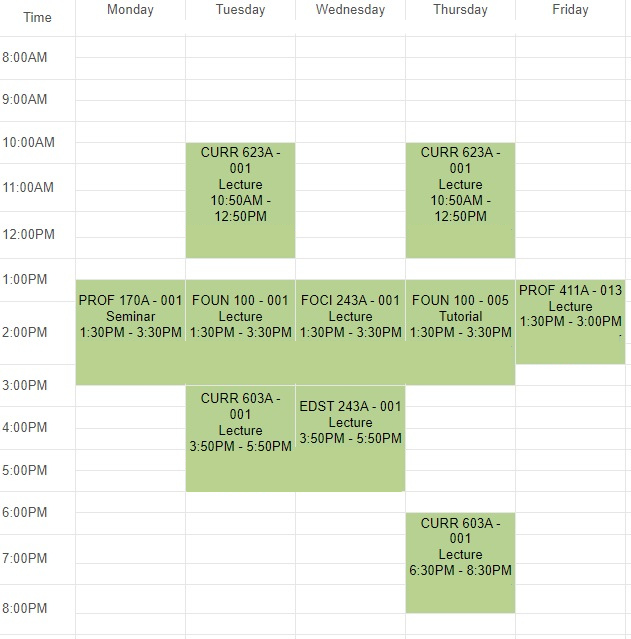
Below are examples of typical weekly schedules for the Fall and Winter terms. Because of the condensed nature of the program, courses change weekly and by term.
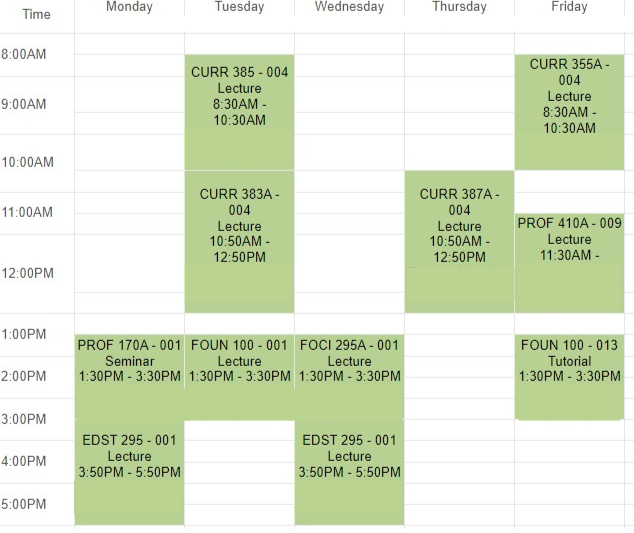
Below are examples of typical weekly schedules for the Fall and Winter terms. Because of the condensed nature of the program, courses change weekly and by term.
ACE Community
The Artist in Community Education (ACE) program is more than classes—it’s a community. Through events, workshops, and arts-based projects, you’ll build lasting friendships, develop professional networks, and collaborate with inspiring artists and educators. Many ACE grads say these connections become the foundation of their careers.
Stay connected after graduation by joining the ACE Alumni Facebook group—a space to share ideas, opportunities, and creative projects with fellow ACE artists.
Got exciting news or stories from your ACE journey? We’d love to hear from you! Share them with Kelly McElrea and help keep our vibrant community inspired.

Admission Requirements
Applicants are required to have an acceptable undergraduate degree (minimum 3-year General degree). Preference is given to applicants with a 4-year Honours undergraduate degree.
Recommendations:
- A minimum “B” average based on the grading scheme of the issuing postsecondary institution.
- 1 half‑year course in Developmental Psychology (or equivalent) or 1 full‑year course in Introductory Psychology (or equivalent).
- Completion of a 4‑year Honours undergraduate degree (20 full‑year courses). If you have less than 20 full-year courses, it is recommended that you take additional courses to add up to 20, as this can be an advantage for salary and advancement.
Notes on Policies:
- Recommended courses provide a broader subject knowledge that will be helpful with a teaching career.
- The recommendations listed in the Admissions Policies are suggested for admission. Having the recommended items may help applicants to be more competitive in the admission process, but applicants may gain admission without the recommended items.
- Unless otherwise specified, throughout the Admissions Policies, a “course” means a university‑level or second‑year CEGEP course.
- “1 full-year course” means a full‑year course or its equivalent (e.g., 2 half‑year courses).
Applicants With a Graduate Degree in Progress
- If you are completing a graduate degree (e.g., MA, MSc) by spring, you may be eligible for additional admission points.
- Indicate on your application that you are enrolled and the anticipated completion date. Provide a final transcript by June 30 showing that the graduate degree was conferred.
Applicants With a University Degree and a College Diploma/Applied Degree
- If you completed 2, 3, or 4 years of a college diploma/applied degree program, you may be eligible to receive additional admission points by submitting an official college transcript, in addition to your university transcript.
- If you have already received substantial university transfer credit for college courses or college credit for university courses, you may not be eligible for such consideration.
The Ontario College of Teachers (OCT) sets its own document and assessment requirements and policies, which may be different from the requirements noted in these policies.
Completing the BEd degree requirements does not guarantee a teaching certificate. All graduates who apply to the OCT must meet all of the OCT requirements.
In addition to the above, preferred status will be given to candidates who have completed at least one half-year undergraduate or graduate course in at least four of the following areas:
- English
- Geography or Canadian History
- Health and/or Physical Education
- Mathematics
- Science
- The Arts (visual arts, music, drama, dance)
- Developmental Psychology or full-year Introduction to Psychology
The first 6 areas are incorporated in the content and pedagogy of Ontario Primary/Junior curriculum.
- Five full‑year courses are required for the first teaching subject; three full‑year courses are required for the second teaching subject (four are required if Music is the second teaching subject). Completing some of the teaching subject courses from upper‑year course offerings at the university level is recommended. Consideration for offers of admission may be given at the discretion of Student Services.
- It is recommended that applicants have a minimum “B” average in the courses that meet the teaching subject requirements.
- Each course taken in preparation for a teaching subject may be used only once towards either teaching subject (i.e., “double counting” is not acceptable).
- A maximum of one full‑year course will be accepted from outside the department of the teaching subject
- Please refer to the Teaching Subject Course Requirements (below) for the required and/or recommended courses for teaching subjects offered in the Queen’s Teacher Education program.
Note: You may have courses on your transcript from a department other than the one that reflects the discipline area. If you are applying to Intermediate/Senior, you must complete the Teaching Subject Course form (provided once you have submitted your application), indicating the courses you feel relate to the teaching subject.
Queen’s must receive all documentation to support the teaching subject course requirements by December 10. Student Services makes the final decision about whether a course meets the discipline area.
Teaching Subject Requirements
Dramatic Arts
Required:
- One full‑year practical studio course (acting or directing); and
- One half‑year course in theatre history (which may include any of the following components: performance in western and eastern theatre traditions from early classical eras to the end of the 19th century, a survey of production methods, and architecture).
Recommended:
- One half‑year course in theatre production (which may include any of the following components: stage management, scenery design, costumes, lighting and sound systems).
English
Required:
- One full‑year course with Canadian content in English literature or poetry; and
- One full‑year or a combination of two half‑year courses in any of the following:
- English literature
- Poetry
- Creative writing
An acceptable equivalent for the full‑year writing course would be one full‑year English course or equivalent that includes an exploration of writing in a variety of literary genres (e.g., poetry, drama, fiction and non‑fictional prose).
First Nations, Métis and Inuit Studies
No additional course requirements beyond the 5 full-year courses required for the first teaching subject and 3 full-year courses required for the second teaching subject.
French as a Second Language*
Required:
- 1 full‑year course with strong overall grammar review at a minimum second‑year level;
- 1 full-year course in writing for accuracy;
- 1 full‑year comprehensive literature course; and
- 1 full‑year oral communication course.
For a second teaching subject, only 3 of the 4 are required.
*If you choose French as a teaching subject, one or more of your practicum placements may take place in a French setting (Immersion, Core, or Extended)
Geography
Required:
- 1 half‑year course in Canadian geography (physical and/or human)
Recommended:
- 1 half-year course in Geographic Information Systems (GIS)/Geomatics/Geo-Informatics, which may include: Cartography and Remote Sensing
- Courses in Physical Geography, which include: Geomorphology, Climatology, Bio-geography, Geography of Soils, Glaciation, Lithosphere and Plate Tectonics, Natural Disasters
- Courses in Human/Economic/Cultural Geography, which include: geography courses that cover global issues, such as tourism, development, environment, poverty, demographics/population, resources, resource management, land use: rural and urban, urban & rural planning, international trade and aid, Environmental Impact Assessment, regional geography (especially Canadian)
- Related courses: Geology, Earth Science
History
Required:
- 1 full‑year survey course in Canadian History
Recommended:
- 2 or more of the following courses central to the History program taught in Ontario high schools:
- Indigenous History
- American History
- Ancient & Medieval History
- Modern European History
- World Politics
Mathematics
Recommended:
- Courses beyond those in the core calculus/analysis stream.
A related course may be considered (up to a maximum of one full‑year course or equivalent) if the course has a math or statistics course listed as an exclusion; in these cases, calendar descriptions listing the exclusion must be sent to Student Services.
Music (Instrumental or Vocal)
Applicants may not select both Music – Instrumental and Music – Vocal as teaching subjects.
Required:
- A minimum of 1 half‑year university course in each of the following areas of music study:
- Music theory
- Additional Music Theory or Music Creation (may include: Composition, arranging, orchestration, electroacoustic)
- Musicology/Ethnomusicology
- A minimum of 1 full‑year university course in each of the following areas of music study
- Applied Music (For instrumental music, applicants must have a minimum of 6.0 units in instrumental lessons or ensembles. For vocal music, applicants must have a minimum of 6.0 units in vocal lessons or ensembles. The applied music course is equivalent to a Grade 8 Conservatory certificate.)
- Music Education or Education-related (1 half-year course required for second teaching subject). May include: conducting, secondary instrument, instrumental techniques (e.g., keyboard skills, vocal tech, guitar tech, brass tech, etc.)
Science – Biology
Required:
- One full‑year course that has a major laboratory component, from a university biology department.
Note: Only one full‑year course in each of biochemistry and human biology will be accepted.
Recommended:
- Any or all of the following courses will be useful: cell biology, ecology, genetics, microbiology, plant and animal (invertebrate and vertebrate – including human) biology.
Science – Chemistry
Required:
- One full‑year course in introductory chemistry; and
- One half‑year course in organic chemistry.
Only one full‑year course in biochemistry will be accepted. Applicants with an undergraduate degree in engineering must specify the chemistry content of each course and supply calendar descriptions.
Science – Physics
Required:
- One full‑year, first‑year introductory physics; and
- One half‑year course in electricity & magnetism beyond first‑year introductory physics.
Applicants with an undergraduate degree in engineering must identify the physics content of each course, using mechanics, sound, optics, and electricity and magnetism as headings, supplemented by calendar descriptions, to indicate the physics content in any course not labelled as Physics.
Social Sciences
Required:
- One full‑year course (or equivalent) in Psychology; and
- One full-year course (or equivalent) in Sociology; and
- One half-year course (or equivalent) in two other general social science subjects including:
- Anthropology
- Cultural Studies
- Gender Studies
- Philosophy
- Indigenous Studies
- Food and Nutrition
- Fashion
- Religion
Visual Arts
Required:
- One-and-a-half full‑year courses in comprehensive studio practice (including at least 2 of: Drawing, painting, printmaking, sculpture, photography, ceramics, or fiber arts) and
- One full‑year survey course in art history (for e.g., Ancient Greece through to the Modern Era) And
- One half-year course in one of: Period-specific Art History OR Thematic Art History; Contemporary Art; Canadian Art History; Indigenous North American Art; Non-Western Art (Eg. Indian, Chinese, Japanese, Islamic); Aesthetics and Art Criticism; History of Architecture; or History of Canadian Architecture
Official Transcripts
- All transcripts submitted must be official, bearing the institutional seal and/or original signature of the institution’s registrar. Photocopied or forwarded transcripts are not acceptable.
- All transcripts, once received, become the property of Student Services and are not returned to you.
- Your previous academic credentials must be obtained at an institution providing an academic environment and education that prepares students for potential success in advanced study at Queen’s.
Official transcripts should consist of:
- Postsecondary transcripts from each institution you attended.
- Ontario transcripts: Request your transcript through the TEAS application.
- Out-of-province transcripts: Request transcripts from the issuing postsecondary institution (including CEGEP, if applicable).
- NOTE: Out-of-province and high school transcripts are to be sent directly to educstudentservices@queensu.ca or:
Student Services
Faculty of Education, Queen’s University
Room A112, Duncan McArthur Hall
511 Union Street
Kingston, ON K7M 5R7
Attention: Jamie Kincaid
International transcripts
For the Bachelor of Education/Diploma in Education, applicants who obtained a degree from a foreign institution (from non-Canadian or American institutions) must have all international official transcripts evaluated by World Education Services (WES) (ICAP course-by-course assessment).
Note that it can take upwards of six weeks for WES to receive official transcripts from a foreign academic institution, after which point the WES evaluation can take a week or longer to complete. Applicants should begin the evaluation process as early as possible.
Ensure you are on the Canadian page (a maple leaf in the banner). Applicants are responsible for the costs associated with the WES evaluation and any translation required. Applicants must request that WES evaluations be sent directly to Student Services by the official transcript deadline.
If you have questions, please contact Student Services.
Please refer to the Ontario College of Teachers (OCT), as their international transcript requirements may differ.
Queen’s University attempts each year to admit a student body reflective of the general population of Canada. The Faculty of Education has developed an admission policy regarding equitable representation of groups that are underrepresented in the teaching profession, and has reserved a number of equity admission places in the Bachelor of Education and Diploma in Education Programs. Those who complete the voluntary Equity Admission form will be considered both under the general admission procedure and under the equity admission policy.
English is the language of instruction at Queen’s University and in the schools in Ontario where our teacher candidates carry out their required practice teaching. Applicants who are non-native speakers of English are required to provide evidence of oral and written proficiency in English in one of two ways:
- Candidates must have studied full-time at least three full years (or the equivalent) at a university where the language of instruction and examination was in English in a country where one of the official languages is English. Time spent in ESL courses or in an ESL program is not counted toward this three-year requirement. Applicants who have attended university other than in North America must submit a letter directly from the university verifying that the language of instruction and examination was English.
Or
- Candidates must have achieved the required level of proficiency on one of the three tests of English language listed below.
The scores listed below are the minimum English Proficiency requirements for admission to our programs. We strongly advise you to complete your test and submit your scores to us well before the published deadline. It may take several weeks before your test results are released until they reach the Faculty of Education. The only acceptable way to submit your test results to Queen’s University is via the testing body.
To match your results to your application, please ensure that you use the same information as your application for admission to Queen’s. This includes first (given), surname (last/family name), date of birth, and gender. We are unable to match the results received with differing information.
- The Test of English as a Foreign Language Internet-based (TOEFL iBT). The TOEFL iBT test code number 8573 must be used to ensure that the results are forwarded directly to the Faculty of Education. Required test scores: Minimum 24 on the Reading component, 23 on the Listening, 28 on each of the Writing and Speaking components, with a minimum 103 overall.
- The International English Language Testing System (IELTS). Request the Academic test. Required test scores: minimum 6.5 on both the Reading and Listening components, and a minimum of 7.0 on the Writing and Speaking components, with a minimum 7.0 overall.
- Canadian Academic English Language Assessment (CAEL). Select “Test Takers” from the top bar menu to access information, including test locations and dates. Required test score: Minimum 70 in all 4 categories and minimum 70 overall.
Candidates admitted to the program who are found to have an unsatisfactory command of the English language, either spoken or written, where their language skills interferes with their ability to communicate effectively in the classroom, may be required to take remedial work or may be asked to withdraw from the program.
In-Class Experience: Practicums
About Practicums
As part of our program, you’ll complete 18 weeks of in-class practicum working alongside experienced education professionals in publicly funded Ontario schools. These hands-on placements give you the opportunity to apply what you’ve learned in our courses directly in real classroom settings – helping you build confidence, develop your teaching skills, and prepare for your future career.
Your practicums are scheduled in blocks and include:
- 3 weeks in your first summer
- 7 weeks during the fall term
- 4 weeks in the winter term
- 4 weeks in your second summer
You’ll also take part in a unique 3-week alternative practicum during the spring term, giving you the chance to explore teaching and learning beyond traditional classrooms—in museums, community programs, educational organizations, and more.
Where Will I Be?
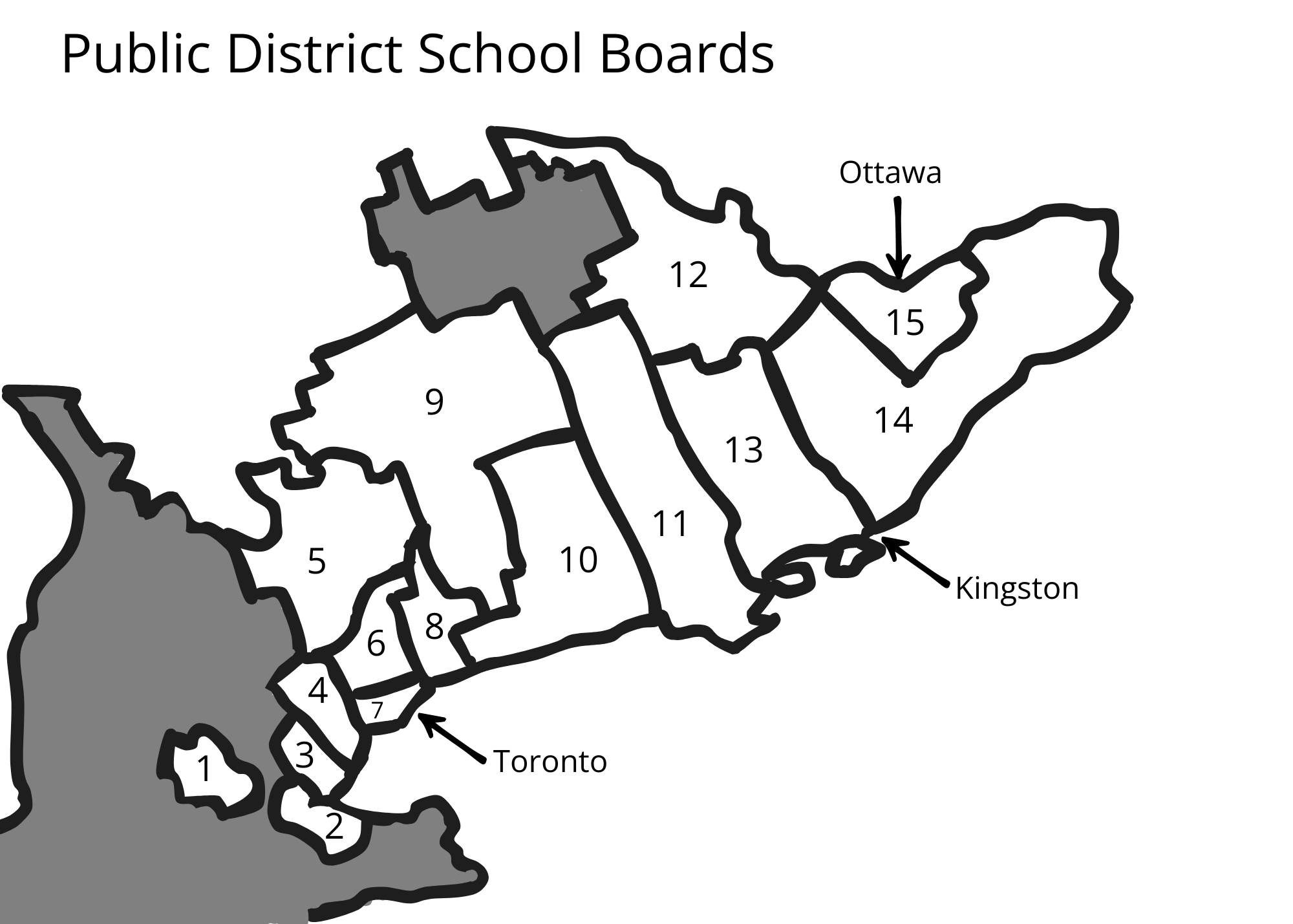
As a teacher candidate in our program, you will complete your practicum placements in schools within our designated catchment area, which spans 28 publicly funded school boards from Burlington to Cornwall.
Whenever possible, we aim to place you in the same associate school for regular practicum blocks. This consistency helps build strong professional relationships and supports your growth as a future educator.
When you are admitted to the program, you’ll be asked to indicate four preferred district school boards within our catchment area. Your practicum will take place in one of these four boards. While we make every effort to place you within approximately a one-hour commute of your home address, we cannot guarantee this. Access to a vehicle can greatly increase your placement options and overall flexibility.
Please note that local Kingston school boards cannot accommodate all of our students. You should be prepared to complete your practicum in other regions within our catchment. This may involve commuting or temporarily relocating during your practicum blocks.
Each year, we coordinate practicum for over 1,000 students across southern Ontario, working with school boards that each have their own timelines and protocols that we have to follow. It’s a complex process—like fitting together pieces of a large and ever-changing
Alternative Practicum
The 3-week Alternative Practicum usually takes place in March and happens outside the traditional school system. For ACE teacher candidates, this practicum is completed in a non-traditional educational, artistic, or arts-education setting—anywhere in the world. Travel fellowships are available to help support international placements.
Past ACE students have completed their alternative practicums at organizations like:
- The National Arts Centre
- The National Gallery of Canada
- The Canadian Opera Company
- The Stratford Festival
- The Shaw Festival
- Random House Publishing UK
- Waterloo
- Hamilton Wentworth
- Halton
- Peel
- Simcoe
- York Region
- Toronto
- Durham
- Trillium Lakelands
- Kawartha Pine Ridge
- Hastings, Prince Edward
- Renfrew
- Limestone
- Upper Canada
- Ottawa-Carleton
.png)
- Waterloo
- Hamilton Wentworth
- Halton
- Dufferin-Peel
- Simcoe
- York
- Toronto
- Durham
- Peterborough, Victoria, Northumberland & Clarington
- Algonquin & Lakeshore
- Renfrew
- Catholic District School Board of Eastern Ontario
- Ottawa
Finance Your Studies
Tuition and Fees
Find information about Tuition and Fees on the Registrar’s website (scroll down to the “education” headline and look under Consecutive & Concurrent (final year) heading. The Registrar & Financial Aid Services website has information on Expenses and Budgeting.
Financial Aid
-
Scholarships & Awards – scroll down to the Faculty of Education Students section to find information on practicum awards.
-
Financial Aid Specifics to Consecutive Education – you can find information specific to the Teacher Education program (both on-campus and multi-session).
-
Automatic Education Awards – some of these awards are based on grades and others are awarded based on nominations from instructors.
-
Named General Bursaries for the Faculty of Education – there are numerous bursaries available specifically for Faculty of Education students.