
The recent changes to teacher education announced by the Ministry of Education will affect the information found on this page. Updates will be made as details are confirmed.
Program is contingent on funding and enrolment.
Our on-campus TechEd program will prepare you to teach grades 9-12 in one of the many broad-based technological areas that are taught in Ontario, including communications technology, computer technology, health care, green industries, technological design, and more.
We have a multi-session (blended) version of this program as well - find out more about the differences.
Overview
- Offered to Consecutive Education teacher candidates.
- There are two program options:
- Bachelor of Education (BEd) Individuals with a combination of work experience and completed post-secondary education, consisting of a post-secondary degree or diploma (min. 2 year) or apprenticeship program acceptable to Skilled Trades Ontario, that totals five (5) years*, of which at least two (2) years* must be work experience in their Broad-based Technology and at least four (4) months in this two year timeframe must be full-time continuous (minimum 35 hours per week) will receive a BEd.
- Diploma in Education (DEd) Individuals with a high school diploma and a minimum 5 years* of work experience, including business or industrial experience, where the applicant used skills and knowledge in the area of Technological Education selected for their Broad-based Technology will receive a DEd. DEd graduates are able to convert their DEd to a BEd by completing a postsecondary degree or diploma or apprenticeship program acceptable to Skilled Trades Ontario, obtaining a red seal, or appealing to Skilled Trades Ontario. Graduates prior to September 2015 are able to convert their DEd to a BEd by completing a postsecondary degree.
*Please note that 1 year equals 1700 hours
- 4 successive terms, starting in May and ending in August the following year. Queen's graduates are out into the job market early.
- Teacher candidates complete 21 weeks of placements, including an alternative practicum that can be done outside a school setting and anywhere in the world as long as it is related to the program.
- Travel fellowships support education-related travel outside Canada such as for alternative practicum placements.
Program Schedule
Summer 1 (May-Aug.) | In-person learning |
|
| Practicum | 3 weeks Practicum (May) | |
Fall 1 (Sept. – Dec.) | In-person learning |
|
| Practicum | 7 weeks of Practicum (Oct. – Nov.) | |
Winter 1 (Jan. – April) | In-person learning |
|
| Practicum | 4 weeks Practicum (Feb. – March) 3 weeks Alternative Practicum (March) | |
Summer 2 (May – Aug.) | In-person learning |
|
| Practicum | 4 weeks Practicum (May) |
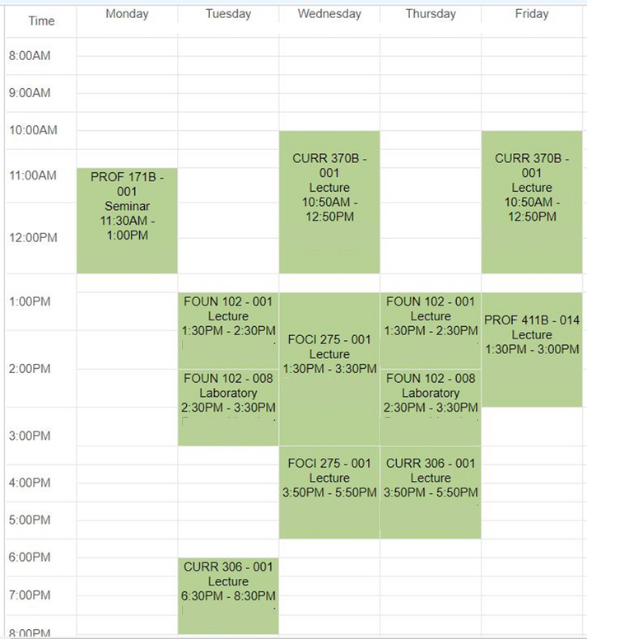
Below are examples of typical weekly schedules for the Fall and Winter terms. Because of the condensed nature of the program, courses change weekly and by term.
Admission Requirements
- Highschool Diploma plus a minimum 5 years* of work experience, including business or industrial experience, where the applicant used skills and knowledge in the area of Technological Education selected for their Broad-based Technology.
or
- At least 2 years* of work experience and successful completion of a postsecondary education program in the area of Technological Education selected for their Broad-based Technology. The postsecondary education program must be a minimum of six (6) semesters of academic studies where the experience and education use the applicant’s skills and knowledge in their Broad-based Technology.
or
- A combination of work experience and education that totals five (5) years*, of which at least two (2) years* must be work experience in their Broad-based Technology and at least four (4) months in this two years must be continuous.
*Please note: 1700 hours represents one year in business or industry of which at least four months must be continuous employment.
Candidates choose from the following Broad-based Technology areas:
- Communications Technology
- Computer Technology
- Construction Technology
- Green Industries
- Hairstyling and Aesthetics
- Health Care
- Hospitality
- Manufacturing Technology
- Technological Design
- Transportation Technology
Compulsory Trade and Service Professionals: If your work experience falls under one of the 23 Compulsory Trades Skilled Trades Ontario (eg. automotive service technician, hairstylist, plumber, electrician, steamfitter), you must hold a Certificate of Qualification authorized under Ontario's skilled trades legislation. Proof of active membership is required in your application.
Detailed Information
Below are the ten Broad-based Technological areas that are taught in Ontario secondary schools. Under each area, we have included some of the specific skills that a future teacher should have to help you determine which Broad-based Technological area fits your related postsecondary skilled work and/or related work experience.
A broad range of technical skills and knowledge are needed in the specific Broad-based Technology to which you are applying. A single technical skill set is not acceptable at this point in time. This means that you should have a minimum range of 2 to 4 skill sets in one Broad-based Technology to be considered for admission.
Communications Technology
- Audio-visual equipment
- Computer electronics
- Electronics/repair
- Graphic artist/designer
- Photography
- Radio and TV arts
Computer Technology
- Hardware and software development
- Computer interfacing
- Programming
- Network setup
- Robot construction
Construction Technology
- Air conditioning and refrigeration
- Cabinet maker
- Carpentry
- Construction
- Electrical/electronics
- Woodworking
Hairstyling and Aesthetics
- Aestheticians must hold a Hairstyling trade certificate.
Health Care
- Registered Nursing certification
- Dental Assistant
- Child care/child development
- Gerontology
Hospitality and Tourism
- Chef
- Hospitality industry
Green Industries
- Agriculture
- Floristry
- Forestry and forest management
- Horticulture and landscaping
- Farming
- Greenhouse operation
Manufacturing Technology
- General machinist
- Tool and Die Maker
- Welding/fabrication
Technological Design
- Architectural/mechanical drafting
- Architectural/mechanical engineer
- Engineering design technologist
Transportation Technology
- Automotive body service technician certification
- Automotive vehicle service technician certification
- Heavy duty/truck service technician certification
- Motorcycle/small engine service technician certification
When you complete our Teacher Education program, you will be prepared to teach students in the Grade 9 Integrated Technologies course, and then courses in one of the above Broad-based Technological areas at the Grades 10-12 levels in which you are qualified.
For more information about secondary school courses, see the following Ministry of Education curriculum documents:
- For Grades 9 and 10: The Ontario Curriculum, Grades 9 and 10: Technological Education, 2009.
- For Grades 11 and 12: The Ontario Curriculum, Grades 11 and 12: Technological Education, 2009.
If the content of the secondary school courses you examined matches your technical background AND a minimum range of 2 to 4 skill sets in one Broad-based Technology, then you should apply to that Broad-based Technology.
If your technical background does not match the content of the secondary school courses you have examined, start this process over to consider another Broad-based Technology.
If you do not find that there is a course that matches your technical background, then you do not have the technical background to apply for a teacher education program in Technological Education. The Ontario secondary school curriculum does not address all technical fields.
Applicants must provide proof of competency in the same Broad-based Technology area to which they are applying in order to teach. This proof is a combination of both academic background and work experience in the same Broad-based Technology. Examples of activities that are not counted towards your skilled work experience are teaching, supervisory functions, management activities, customer service, and sales activities. Activities such as these cannot be counted even if they require knowledge of the Broad-based Technology area.
Proof of competence in the Broad-based Technology subject area must be demonstrated as follows:
- a minimum of 2 years of related postsecondary skilled work and/or work experience (in the same area of trade certification and in the same Broad-based Technology subject area that the applicant is seeking qualification)
or
- an acceptable combination of related academic studies and related skilled work experience
- Related university or college degree: A minimum of 2 years experience
- Unrelated university or college degree: A minimum of 5 years experience
- Related three (3) year college diploma: A minimum of 2 years experience
- Related two (2) year college diploma or Apprenticeship: A minimum of 3 years experience
- Tradesperson (Secondary School Graduation Diploma): A minimum of 5 years experience
*Please note: 1700 hours represents one year in business or industry of which at least four months must be continuous employment.
Selection is based on the application requirements in TEAS Requirements for Queen's as well as the supplemental documents submitted to Student Services. See How to Apply.
Apply now at: TEAS
Official Transcripts
- All transcripts submitted must be official, bearing the institutional seal and/or original signature of the institution’s registrar. Photocopied or forwarded transcripts are not acceptable.
- All transcripts, once received, become the property of Student Services and are not returned to you.
Your previous academic credentials must be obtained at an institution providing an academic environment and education that prepares students for potential success in advanced study at Queen’s.
Official transcripts should consist of:
- Postsecondary transcripts from each institution you attended.
- Ontario transcripts: Request your transcript through the TEAS application.
- Out-of-province transcripts: Request transcripts from the issuing postsecondary institution (including CEGEP, if applicable).
- NOTE: Out-of-province and high school transcripts are to be sent directly to educstudentservices@queensu.ca or:
Student Services
Faculty of Education, Queen’s University
Room A112, Duncan McArthur Hall
511 Union Street
Kingston, ON K7M 5R7
Attention: Jamie Kincaid
International transcripts
For the Bachelor of Education/Diploma in Education, applicants who obtained a degree from a foreign institution (from non-Canadian or American institutions) must have all international official transcripts evaluated by World Education Services (WES) (ICAP course-by-course assessment).
Note that it can take upwards of six weeks for WES to receive official transcripts from a foreign academic institution, after which point the WES evaluation can take a week or longer to complete. Applicants should begin the evaluation process as early as possible.
Ensure you are on the Canadian page (a maple leaf in the banner). Applicants are responsible for the costs associated with the WES evaluation and any translation required. Applicants must request that WES evaluations be sent directly to Student Services by the official transcript deadline.
If you have questions, please contact Student Services.
Please refer to the Ontario College of Teachers (OCT), as their international transcript requirements may differ.
Queen’s University attempts each year to admit a student body reflective of the general population of Canada. The Faculty of Education has developed an admission policy regarding equitable representation of groups that are underrepresented in the teaching profession, and has reserved a number of equity admission places in the Bachelor of Education and Diploma in Education Programs. Those who complete the voluntary Equity Admission form will be considered both under the general admission procedure and under the equity admission policy.
English is the language of instruction at Queen’s University and in the schools in Ontario where our teacher candidates carry out their required practice teaching. Applicants who are non-native speakers of English are required to provide evidence of oral and written proficiency in English in one of two ways:
- Candidates must have studied full-time at least three full years (or the equivalent) at a university where the language of instruction and examination was in English in a country where one of the official languages is English. Time spent in ESL courses or in an ESL program is not counted toward this three-year requirement. Applicants who have attended university other than in North America must submit a letter directly from the university verifying that the language of instruction and examination was English.
Or
- Candidates must have achieved the required level of proficiency on one of the three tests of English language listed below.
The scores listed below are the minimum English Proficiency requirements for admission to our programs. We strongly advise you to complete your test and submit your scores to us well before the published deadline. It may take several weeks before your test results are released until they reach the Faculty of Education. The only acceptable way to submit your test results to Queen’s University is via the testing body.
To match your results to your application, please ensure that you use the same information as your application for admission to Queen’s. This includes first (given), surname (last/family name), date of birth, and gender. We are unable to match the results received with differing information.
- The Test of English as a Foreign Language Internet-based (TOEFL iBT). The TOEFL iBT test code number 8573 must be used to ensure that the results are forwarded directly to the Faculty of Education. Required test scores: Minimum 24 on the Reading component, 23 on the Listening, 28 on each of the Writing and Speaking components, with a minimum 103 overall. Test results are valid for 2 years.
- The International English Language Testing System (IELTS). Request the Academic test. Required test scores: minimum 6.5 on both the Reading and Listening components, and a minimum of 7.0 on the Writing and Speaking components, with a minimum 7.0 overall. Test results are valid for 2 years.
- Canadian Academic English Language Assessment (CAEL). Select “Test Takers” from the top bar menu to access information, including test locations and dates. Required test score: Minimum 70 in all 4 categories and minimum 70 overall. Test results are valid for 2 years.
Candidates admitted to the program who are found to have an unsatisfactory command of the English language, either spoken or written, where their language skills interferes with their ability to communicate effectively in the classroom, may be required to take remedial work or may be asked to withdraw from the program.
Candidates graduating without an undergraduate degree may be limited in the Additional Qualifications/Additional Basic Qualification courses they can take in the future. Please see the OCT website for further information.
Continuing Teacher Education Courses for TechEd Diploma of Education Alum
Courses and Practicum
In the program you will take some courses that are common to all education programs, as well as courses specific to Technological Education including CURR 360: Teaching Technological Education, CURR 368: Curriculum Development in Technological Education, and FOCI 213: Broad-Based Technological Education
These courses will introduce new ideas and practices, and ask you to critically reflect on how you will practice as an educator. Our faculty has a technological education shop specifically designed for project development and learning about the teaching of technological education.
About Practicums
As part of our program, you’ll complete 18 weeks of in-class practicum working alongside experienced education professionals in publicly funded Ontario schools. These hands-on placements give you the opportunity to apply what you’ve learned in our courses directly in real classroom settings – helping you build confidence, develop your teaching skills, and prepare for your future career.
Your practicums are scheduled in blocks and include:
- 3 weeks in your first summer
- 7 weeks during the fall term
- 4 weeks in the winter term
- 4 weeks in your second summer
You’ll also take part in a unique 3-week alternative practicum during the spring term, giving you the chance to explore teaching and learning beyond traditional classrooms—in museums, community programs, educational organizations, and more.
Technological Education Specifics
As a TechEd teacher candidate, you'll placed in secondary schools in Technology and Skilled Trades (Intermediate) and/or in the Broad-Based Technological (BBT) Education curriculum that you are seeking certification for.
Not all Broad-Based Technologies are offered and run in every partner district school board. This means that you may need to be prepared to expand your four district school board selection if your senior Broad-Based Technology subject is not offered within your selected district school board.
Where Will I Be?
You will complete your practicum placements in schools within our designated catchment area, which spans 28 publicly funded school boards from Burlington to Cornwall.
Whenever possible, we aim to place you in the same associate school for regular practicum blocks. This consistency helps build strong professional relationships and supports your growth as a future educator.
When you are admitted to the program, you’ll be asked to indicate four preferred district school boards within our catchment area. Your practicum will take place in one of these four boards. While we make every effort to place you within approximately a one-hour car commute of your home address, we cannot guarantee this. Access to a vehicle will greatly increase your placement options and overall flexibility.
Please note that local Kingston school boards cannot accommodate all of our teacher candidates. You should be prepared to complete your practicum in other regions within our catchment. This may involve commuting or temporarily relocating during your practicum blocks.
Each year, we coordinate practicum for nearly 1,000 teacher candidates across southern Ontario, working with school boards that each have their own timelines and protocols that we follow. It is a complex process—like fitting together pieces of a large and ever-changing puzzle. Please note that teacher candidates are not allowed to arrange their own practicums.
Alternative Practicum
The three-week alternative practicum offers you the opportunity to explore teaching and learning outside the traditional school system – anywhere in the world. Typically completed in March, this practicum aligns with the goals of the TechEd program and provides a chance to broaden your educational experience in a setting that supports your professional interests.
Examples of previous placements for the Tech Ed program include tourist resorts, community colleges, radio and television corporations, and many others in business and industry. Guidance and support will be given in selecting your placement.
You are responsible for arranging your own alternative practicum placements. These can take place anywhere in the world, offering a unique opportunity to gain international or community-based experience. Travel Fellowships are available to help offset associated costs.
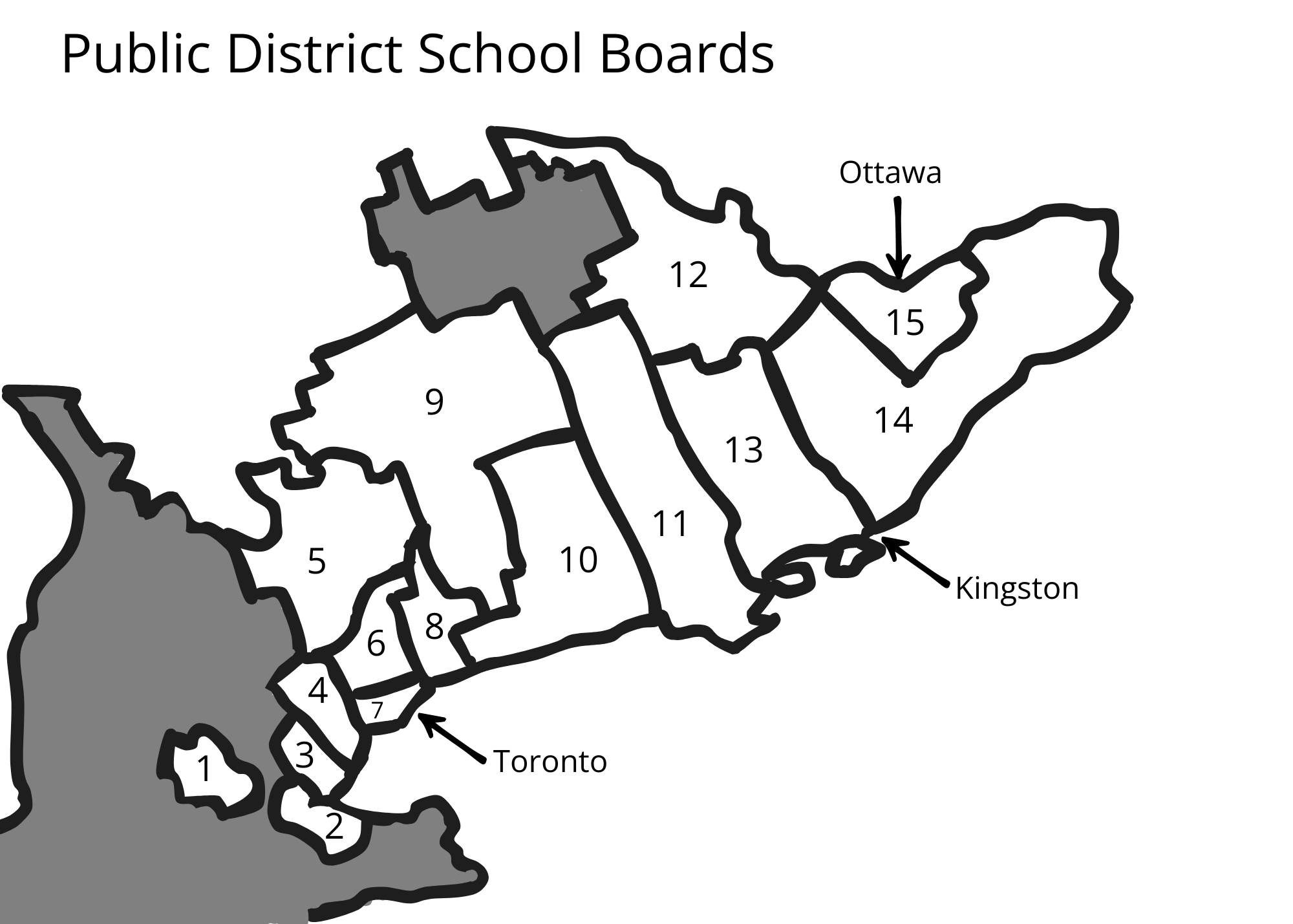
- Waterloo
- Hamilton Wentworth
- Halton
- Peel
- Simcoe
- York Region
- Toronto
- Durham
- Trillium Lakelands
- Kawartha Pine Ridge
- Hastings, Prince Edward
- Renfrew
- Limestone
- Upper Canada
- Ottawa-Carleton
.png)
- Waterloo
- Hamilton Wentworth
- Halton
- Dufferin-Peel
- Simcoe
- York
- Toronto
- Durham
- Peterborough, Victoria, Northumberland & Clarington
- Algonquin & Lakeshore
- Renfrew
- Catholic District School Board of Eastern Ontario
- Ottawa
Finance Your Studies
Tuition and Fees
Find information about Tuition and Fees on the Registrar’s website (scroll down to the “education” headline and look under Consecutive & Concurrent (final year) heading. The Registrar & Financial Aid Services website has information on Expenses and Budgeting.
Financial Aid
Scholarships & Awards – scroll down to the Faculty of Education Students section to find information on practicum awards.
Financial Aid Specifics to Consecutive Education – you can find information specific to the Teacher Education program (both on-campus and multi-session).
Automatic Education Awards – some of these awards are based on grades and others are awarded based on nominations from instructors.
Named General Bursaries for the Faculty of Education – there are numerous bursaries available specifically for Faculty of Education students.